



Share this post


If you have breast implants and notice new or concerning symptoms, it can be difficult to know what the issue might be. Online, you’ll often see extremes. Some posts sound alarming, while others dismiss concerns outright, and neither helps you think clearly.
Breast explant surgery is an option for patients who want implants removed due to discomfort, lifestyle changes, implant-related concerns, or symptoms they want to evaluate in coordination with their physician.
The goal is clear: remove the implants safely, preserve breast tissue, and plan the desired breast shape afterward. Below, we review capsule management options, recovery expectations, and how to select a breast explant surgeon in Beverly Hills.
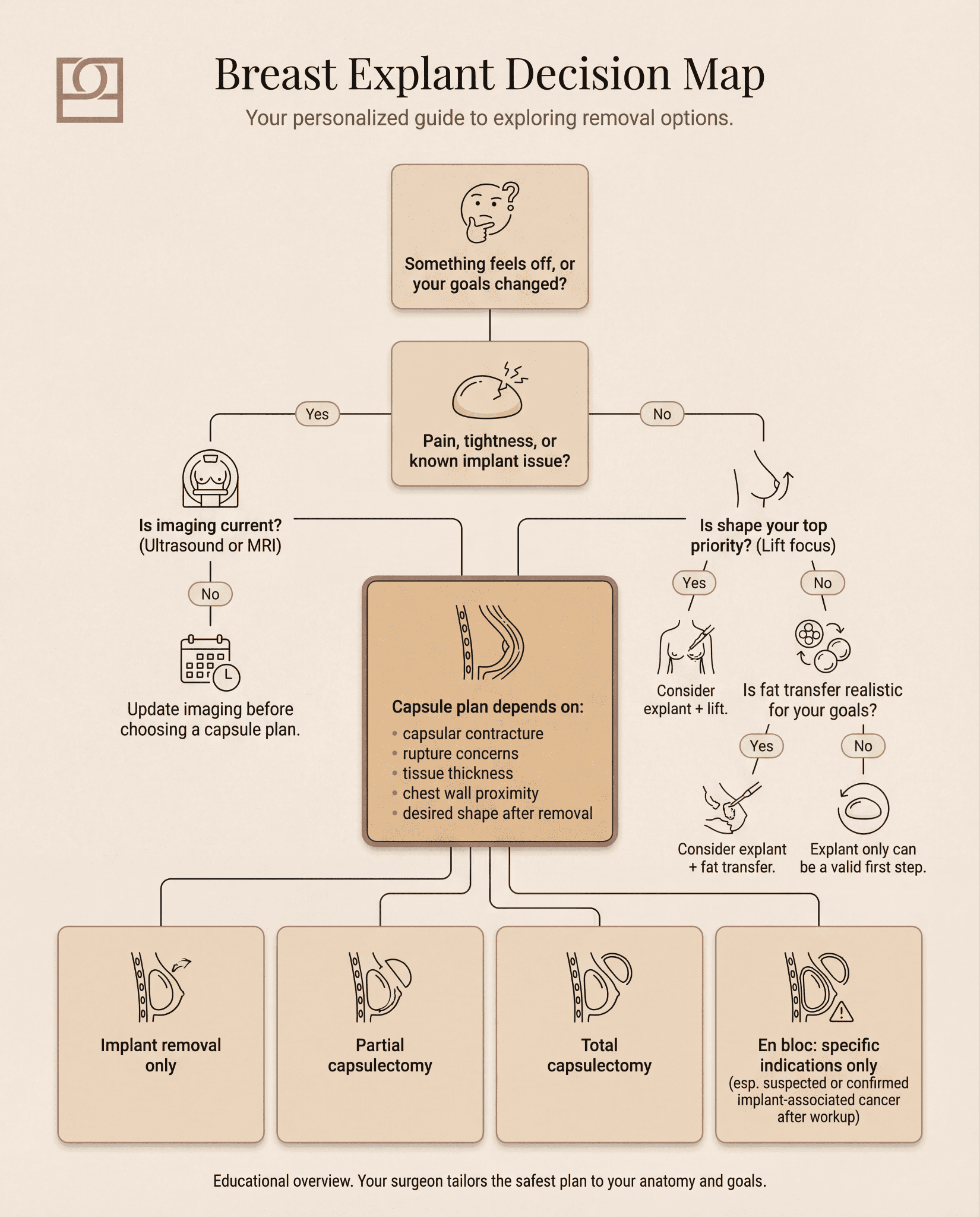
Breast explant surgery removes breast implants. During the same procedure, your surgeon evaluates the capsule, the scar tissue that naturally forms around an implant, and decides how much to remove.
That decision is personal, but it is guided by clinical factors. Surgeons consider capsular contracture, rupture concerns, tissue thickness, how closely the capsule adheres to the chest wall, and the shape you want afterward. The same variables often guide planning in revision surgery versus implant removal.
You may hear these terms:
Timing can matter too. Cleveland Clinic notes implants often last about 10 to 15 years, though complications can drive surgery sooner or later.
There is no single “right” reason. In practice, most decisions fall into a few common buckets, and you may relate to more than one.
Some patients choose breast explant surgery after a complication or an imaging finding that shifts the plan. Common triggers include capsular contracture, suspected rupture, persistent pain, or a tight, “pulled” sensation that does not improve.
If tightness is the main complaint, understanding capsular contracture and the treatment pathways helps clarify the next steps.
These concerns also guide capsule decisions. In a peer-reviewed review of capsulectomy practices, contracture and rupture were the leading reasons surgeons removed capsule tissue, underscoring the need for a surgical approach tailored to each case.
Some patients report systemic symptoms and question a possible association with breast implants.
To ground the discussion, it helps to look at what has been formally reported. In its reports, the FDA lists symptoms that women have described, including fatigue, memory or concentration problems (“brain fog”), and joint or muscle pain.
Goals change. You may want a smaller, more natural look, or you may feel your implants no longer match your body or style.
Athletic training, posture changes, pregnancy, weight changes, and aging can all shift how implants feel day to day. If your implants feel like they are “in the way,” that is valid information, not vanity.

Breast implant illness (BII) is a term used to describe a cluster of systemic symptoms that some patients associate with implants. The key nuance is that BII is not a single diagnosis with one definitive test, so evaluation focuses on symptom patterns, timing, and ruling out other causes.
So what does that mean for you?
It means decisions should be guided by a structured evaluation. A consultation should incorporate your symptoms and history, assess implant status, and outline a plan to evaluate other causes and discuss surgical options with clear expectations.
Most patients want a simple, concrete picture. Here is the usual sequence.
Your surgeon starts by reviewing your implant history, including the type, placement, and length of time you’ve had them.
Then the conversation shifts to your symptoms and goals, because those details guide the surgical plan. If imaging is outdated or rupture is a concern, Dr. Lisa Cassileth may recommend updated studies before scheduling, so the capsule plan matches what your body needs, not guesswork.
Breast explant surgery is performed under general anesthesia, with the patient asleep throughout. Procedure time varies, and the main drivers are implant placement, the amount of scar tissue, and whether you’re combining an explant with a lift or another reshaping step.
Your surgeon should outline a realistic range during your consultation so you know what to expect.
A practical way to understand options is this quick comparison:
| Approach | What it means | Common reasons it may be chosen |
| Implant removal only | Implant removed, capsule left alone or adjusted. | Minimal capsule concerns, lower surgical discussions. |
| Total capsulectomy | Capsule removed completely. | Significant contracture, rupture considerations, and surgeon judgment. |
| En bloc | Implant and capsule removed together as one unit. | Specific indications, especially suspected or confirmed malignancy. |
If your surgeon removes capsule tissue, they may send it to pathology, especially when your history or what they see during surgery calls for a closer look.
That step helps document findings and rule out uncommon concerns. Before surgery, your surgeon should explain what they plan to remove, what will be tested, and the reasoning behind those choices.
Once implants are removed, your skin and breast tissue no longer have the same internal support. That is why it helps to compare potential add-on procedures side by side.
| Option | What it does | Best fit when | Trade-offs to know | Recovery notes |
| Explant only | Removes implants, may leave or adjust capsules per plan. | You want removal first, and your skin tone is still decent. | Upper fullness can drop, and loose skin may be more noticeable. | Often, the simplest recovery timelines still vary. |
| Explant + Breast lift (mastopexy) | Tightens skin, reshapes the breast mound, and re-centers the nipple. | Sagging is your main concern, or you want a more “supported” shape. | Adds scars and incision healing considerations. | Recovery can feel more “surgical” than explant alone. |
| Explant + Fat transfer | Adds volume using your own fat, often to the upper pole. | You want softness and modest fullness without implants. | Volume is not unlimited; some fat may not “take”. | Includes healing at the donor area plus the breast. |
| Explant + Lift + Fat transfer | Reshapes and restores selective volume. | You want both a better position and a bit of fullness. | The most complex plan may require staging in some cases. | Longer overall healing curve, more follow-ups |
If you’re unsure, the best next step is to define your priority: shape, fullness, or keeping surgery as minimal as possible. That single choice usually clarifies the plan.
“En bloc” capsulectomy means the surgeon removes the implant and its surrounding capsule together as a single intact unit. Because it sounds like the “best” option online, it is often requested.
Still, the safest approach depends on what your surgeon can remove without increasing risk to your breast tissue or the chest wall.
Definitions matter. The Aesthetic Society’s consensus statement specifies that en bloc capsulectomy is absolutely indicated only when breast implant-associated cancer is suspected or confirmed following appropriate evaluation. Routine implant removal does not inherently require an en bloc approach.
If symptoms worry you, that concern is valid. The next step is choosing a capsule plan that fits your anatomy and findings.
Recovery after breast explant surgery depends on what’s included in your plan. Implant removal alone is often a simpler healing course, while adding a lift requires more incision care, and fat transfer can lead to soreness at the collection site.
Even so, the overall rhythm is similar. You’ll usually feel better in stages, not in a straight line.
Here’s a timeline many patients recognize, with the understanding that your surgeon may adjust milestones based on your body and the specifics of your procedure.
| Timeframe | What you may notice | What the focus usually is |
| Week 1 | Swelling, bruising, tightness, fatigue, and “pressure” sensations are common. | Rest, short walks, surgical bra support, incision care, pain control |
| Weeks 2-3 | Daily movement feels easier, swelling often starts to taper, and energy returns gradually. | Light activity, desk work for many patients, continued garment use if advised |
| Weeks 4-6 | You may feel “almost normal,” yet deep healing is still underway. | Gradual return to exercise with clearance, avoid chest strain, monitor swelling changes |
| Months 3-6 | Shape continues to settle, scars soften, skin contracts and refines. | Scar care plan, patience with final contour, follow-ups to confirm healing progression |
A few practical habits make recovery smoother. Keep follow-up visits even if you feel fine, because surgeons can spot small issues early. Protect your incisions and scars exactly as instructed. And ease back into activity, since doing too much too soon can prolong swelling and affect scar quality.
After breast explant surgery, the breast may look smaller and softer right away. Skin laxity, loss of upper fullness, and some asymmetry can happen. How noticeable these changes are depends on:
A tailored plan can reduce a ‘deflated’ look. Options may include a lift, fat transfer, staging, or selective support, including GalaFLEX surgical mesh, when appropriate
Explantation can feel like a clear step forward, yet it can also bring up emotions you did not expect. A rapid change in silhouette can lead to relief, grief, or a mix of both.
A supportive process helps:
A 2022 prospective PubMed study found that quality-of-life scores improved after explantation and that satisfaction with breasts increased, supporting emotional recovery as part of the overall plan rather than an afterthought.
Breast explant surgery results rarely look “finished” at two weeks, even though the implants are already out. Early swelling can make breasts look higher, wider, or uneven, and then tissue recoil and skin contraction gradually refine the shape.
Scars also soften over time, which can change how the breast sits and moves.
Many surgeons discuss a settling window of several months, especially if a lift or fat transfer is part of the plan.
A realistic outcome usually blends comfort with aesthetics. You’re aiming for less tightness, a shape that fits your body now, and a clear long-term plan if you want additional reshaping later.

If you are on the fence, focus on the questions that actually change the decision.
A well-planned consultation does not rush you. It maps options, explains trade-offs, and helps you choose the safest plan that still respects your goals.
Every surgery carries risk, and breast explant surgery is no different. Still, understanding the “why” behind each risk makes the plan easier to follow.
Common risks to discuss include:
Capsule work can add complexity because your capsule may be thick, tightly adherent, or close to the chest wall.
A peer-reviewed review explains that surgeons choose different capsulectomy techniques based on the indication, and these differences affect the amount of dissection and potential complication risk, so your plan should be tailored to your anatomy.
When you search for breast explant surgery in Beverly Hills, you’ll see confident claims.
Even so, choosing a surgeon often comes down to revision-level experience and decision-making, since explantation can involve complex choices about the capsule, tissue support, and final shape.
First, confirm board certification in plastic surgery and consistent experience with explant and revision cases. At The Practice Healthcare, Dr. Lisa Cassileth, MD, FACS, brings innovations and a complex breast surgery background to implant and explant planning.
Next, review before-and-after photos that mirror your goal: natural, lifted, smaller, or restored volume with fat transfer. Finally, let the consultation confirm your fit. You should feel heard, get direct answers, and leave with realistic expectations.
The most common pairings are:
Some patients ask about skin-tightening devices for mild laxity. Those can be discussed on a case-by-case basis, but surgery remains the primary tool when skin excess is significant.
Costs vary because breast explant surgery in Beverly Hills can mean implant removal alone, implant removal plus capsulectomy, or explant combined with a lift or fat transfer.
Price is driven by surgical complexity, operating room and anesthesia time, surgeon expertise, and facility standards. When you compare quotes, look at what’s included, especially follow-ups, garments, and revision planning, not only the headline number.

Considering breast explant surgery takes real thought, especially when online advice pulls in every direction. A good consultation brings things back to basics.
You get clear, plain-language guidance on capsule options, expected recovery, and what your shape can realistically look like as healing progresses.
For breast explant surgery in Beverly Hills, Dr. Lisa Cassileth and The Practice Healthcare team can review your implant history, listen to your concerns, and map a plan that prioritizes safety, capsule strategy, and the shape you want after recovery.
When you want to move forward, schedule a consultation to start a calm, no-rush conversation.
Insurance may help cover the cost of removal when it is medically necessary, such as due to rupture, severe contracture, or infection. Ask the office for documentation needs and codes, then confirm with your insurer. Even with coverage, costs can include deductibles, anesthesia, and facility fees.
You’ll notice an immediate size change, but refinement takes time. Swelling and tissue recoil can shift week to week, so avoid judging early. Most contour settles over months, especially when a lift or fat transfer is added.
Re-augmentation is possible, but it works best after your tissues fully heal and your goals are clear.
During planning, your surgeon will assess skin quality, pocket stability, and scar position, and they’ll often revisit the basics of augmentation planning to set timing and expectations.
Some patients choose a staged approach or consider fat transfer instead.
Yes. A lift can restore shape and nipple position, while fat transfer can add subtle upper fullness.
Your outcome depends on skin elasticity, implant size history, and tissue support. In breast explant surgery in Beverly Hills, surgeons personalize options to avoid a flat look.
Not automatically. En bloc means removing the implant and capsule together, and consensus guidance limits it to specific situations, especially suspected or confirmed implant-associated cancer. For systemic symptoms, your surgeon weighs imaging, capsule features, and safety. Discuss breast explant surgery in Beverly Hills options without pressure.