



Share this post


How long does tummy tuck recovery time really take, and what will your days feel like while you heal? If you are planning time off work or arranging childcare, you need a practical timeline.
Recovery moves in phases, yet your pace depends on procedure details, especially muscle repair, as well as supports like compression and drains. Many people feel better in about 2 weeks, yet swelling can linger for months, so track 2 lanes: function and appearance.
At The Practice Healthcare, we help you map a realistic timeline that aligns with your lifestyle, job demands, and comfort priorities, so you know what to expect and when to reach out.
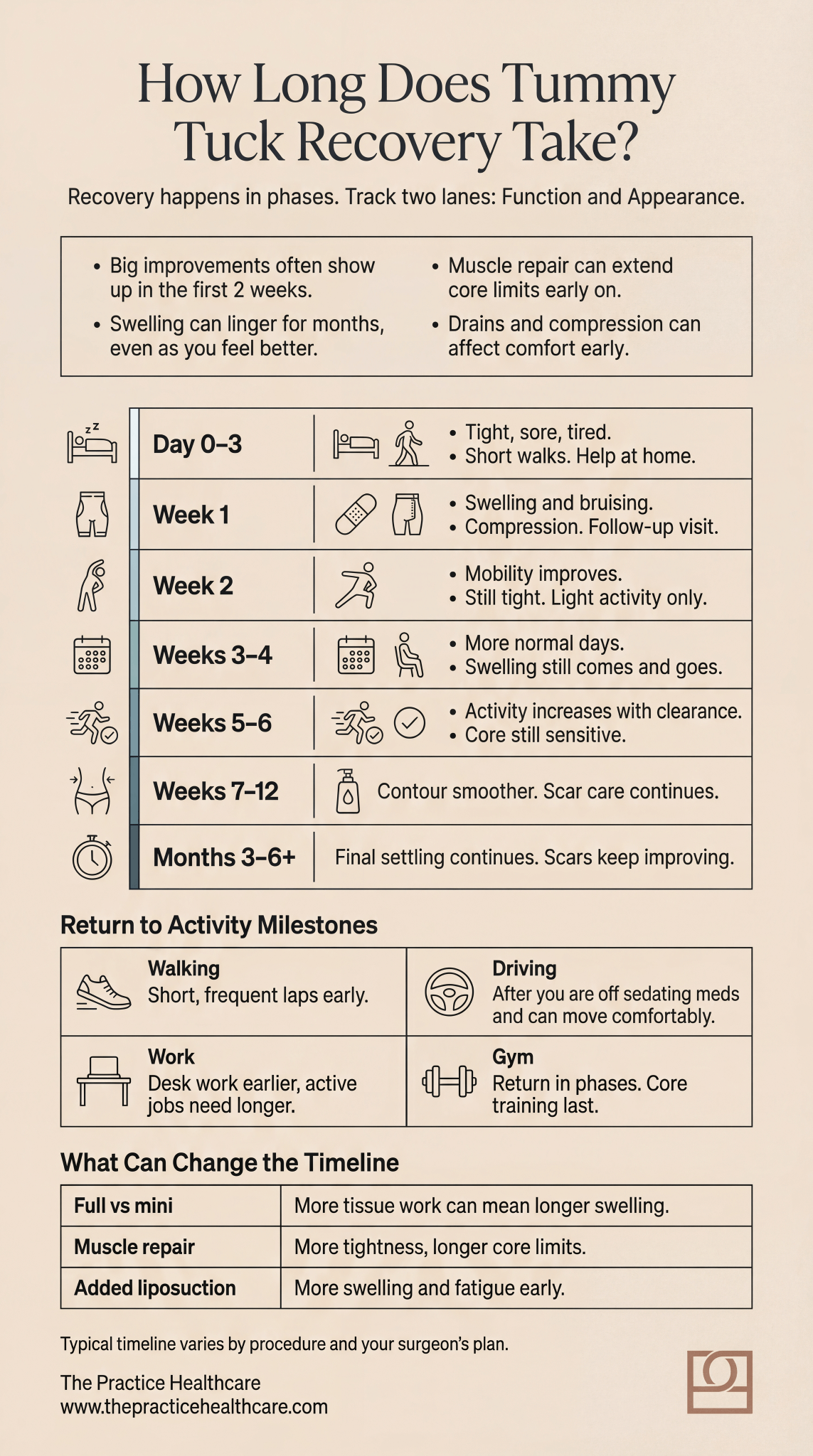
Recovery after a tummy tuck works best in two lanes. One lane is functional recovery, the day-to-day return of walking comfortably, standing straighter, driving safely, and getting back to work.
The other lane is aesthetic recovery, when swelling eases, scars mature, and your contour settles.
These lanes can move at different speeds, so feeling “good” can arrive before you look fully “settled.” Mayo Clinic notes that many people return to work in about 2 to 4 weeks, even while swelling can linger.
Use this week-by-week guide to plan comfort steps, activity limits, and swelling milestones.
You can expect tightness, soreness, fatigue, and a slightly bent posture as your abdomen feels “pulled.”
You will usually need help at home, even if you are independent by nature.
Priorities that matter in this window:
Swelling and bruising tend to be obvious, and your abdomen can feel firm and guarded. You may still walk with a careful posture, and you will likely need frequent rest breaks.
Common supports:
Simple daily goals that keep you grounded:
According to the Cleveland Clinic, discomfort, bruising, and a tight “pulling” sensation are common during the initial week.
Mobility often improves, so you may need less help at home. You can still feel tight and “stretched” when you stand longer.
Discomfort often shifts into pressure and pulling, and swelling can spike later in the day after extra steps. Light daily activity can be increased with surgeon clearance, while lifting and core bracing remain limited.
A BMC Surgery study reported that 65.3% of patients had returned to normal activity by 30 days after abdominal surgery, which is a useful reminder that week two often marks meaningful progress, not the finish line.
Energy often feels steadier now, and walking can feel smoother, so your days start looking more normal.
With that added comfort, it is easy to forget that you are still healing on the inside.
Swelling still shows up, especially later in the day, after errands, or after longer stretches on your feet. You might look flatter in the morning and puffier at night, which is common. Restrictions still matter in this window because internal healing keeps moving even when the outside looks calm.
By weeks 5 to 6, many patients receive clearance to increase activity once swelling is stable and incisions are calm. If muscle repair was part of your plan, your core can still feel tight when you reach, twist, or try to move quickly.
Posture often returns to a more normal state, and daily movement feels less guarded, yet heavy lifting and strenuous workouts may still be limited.
Swelling often eases here, so your contour looks smoother, and clothes may fit differently again. Some days feel completely normal.
Others end with a little puffiness after errands, travel, or a longer time on your feet, and that is still within the expected range.
Scar care stays in rotation, since the incision can look pinker or feel firmer before it calms down. If the gym matters to you, workouts often return with clearance and a slow build, keeping core strain on pause.
By months 3 to 6, your abdomen often looks smoother and feels softer, even if you still notice a little firmness.
Swelling can flare after travel, long walks, or salty meals, so evenings may look slightly fuller. Comfort often leads to the mirror. You may also think about recovery less often, because daily movement feels natural again and routines return.
For a broader view of treatment options and outcomes, explore our body procedures.

Use these milestones to match walking, driving, work, and workouts to safe healing progress.
Early walking is usually encouraged in short, frequent intervals, and your pace should match your level of steadiness.
A few minutes at a time add up. It also helps reduce stiffness and keeps circulation moving.
Stairs are often fine with support and a slow, deliberate rhythm. Use the handrail. Take one step at a time if needed. Avoid carrying anything that makes you brace your core, because that extra tension can trigger soreness and swelling, even when the incision looks calm.
Driving usually resumes when you can move smoothly and stay alert, not simply when you feel bored at home.
You need to sit comfortably, brake without hesitation, and turn enough to check mirrors without pulling. Pain medicine can also change reaction time, so timing matters.
Practical readiness signs include:
Returning to work is not only about pain. It is also about lifting, commuting, and how long you can sit without bracing your core.
You will probably be able to return to work in 2 to 4 weeks and should avoid strenuous activity and straining for 4 to 6 weeks, which is why your job duties matter as much as the calendar.
Gym progress works best in phases, because your incision and any muscle repair need time to tolerate pressure.
Light cardio often returns earlier; keep it gentle and steady so your core stays quiet.
As your stamina builds, you can progress to lower-body training with a gradual load increase and careful setup. You can resume upper body work once you can lift without heavy bracing or strain.
Core training usually comes back last, since even small moves can create strong tension while tissues are still tightening and settling.
| Factor | How can it affect your recovery time | What you may notice |
| Full vs mini tummy tuck | More tissue work and a longer incision often mean more swelling and a longer “tight” phase. A mini tummy tuck can reduce downtime for some patients, yet technique and baseline tissue quality still matter. | Longer soreness or tightness, slower swelling drop, longer time to feel fully upright. |
| Muscle repair | Muscle repair can increase early tightness and often extends core restrictions because the repair needs time to strengthen. It can also delay a fully upright posture even when the incision looks good. | Stronger “pulled” feeling, slower posture change, and core fatigue with simple movements. |
| Adding liposuction or combining procedures | Added contouring can increase swelling and fatigue early on. Multiple healing areas can change how soreness feels and how quickly energy returns. | More widespread swelling, longer fatigue, and more sensitivity with activity. |
| Body factors and lifestyle | Nicotine exposure can reduce healing quality, so surgeons often require a nicotine-free window. Nutrition, hydration, and sleep influence swelling and energy. Chronic conditions can change pacing and follow-up needs. | More swelling fluctuations, slower energy return, need for closer follow-up, or longer restrictions. |
Healing tends to go more smoothly with consistent routines.
NHS After Surgery Advice notes early movement supports recovery, so short walks matter. This routine can help keep swelling more stable and give you simple daily checkpoints to track progress.

Swelling tends to fluctuate as it gradually settles.
Early swelling can feel constant, while later swelling often comes and goes after errands, travel, or long days on your feet.
Evening puffiness is common after extra activity, even when you did everything “right.”
Tightness can feel like pulling because tissues were repositioned and repaired, so standing fully upright may take time. That sensation usually softens as swelling drops, and your body adapts to the new tension.
Numbness is also common in the lower abdomen and can improve slowly over weeks to months as nerves recover and sensation becomes less patchy.
Drains are often used to reduce fluid buildup and support healing.
Drain removal usually depends on output trends and your surgeon’s plan. A peer-reviewed Aesthetic Plastic Surgery Analysis of prolonged drains after abdominoplasty reports typical drain durations of several days, with longer outliers that depend on risk factors and surgical context.
Incision appearance also changes in phases:
You should have a clear threshold for when to call. Contact your surgeon promptly for:
Seromas and other fluid collections can appear after surgery, often around the week mark, and your surgeon can guide evaluation and treatment. Seromas often occur around 7 to 10 days after wound closure or drain removal.
If anything feels urgent or unclear, it's a good idea to contact our team to guide your next steps.
Early results can look swollen, and contour refines as swelling decreases.
You might see a flatter abdomen early, but definition sharpens later as firmness softens and swelling drops further, especially around the lower belly and sides. It is also normal to notice day-to-day fluctuation, with mornings looking smoother than evenings.
Scars follow their own timeline, often remaining pink or firm before gradually fading and flattening. If you want to understand the safety standards and support systems behind your care, visit our surgery center.

Tummy tuck recovery time follows predictable phases, yet your calendar depends on procedure details, muscle repair, and how your body handles swelling.
Daily comfort may return sooner than your final contour, so it helps to plan around both.
At The Practice Healthcare, we translate your goals into a clear timeline, including walking targets, drainage and compression guidance, and realistic return-to-work and workout milestones. For help navigating coverage and paperwork alongside your surgical plan, review our patient advocacy resources.
When you are ready to map your next steps, schedule a consultation.
A full tummy tuck usually has a longer healing arc because the incision and tissue work cover a larger area. Many people feel noticeably better in about 2 weeks, while tummy tuck recovery time continues to improve for several months as swelling settles.
Most patients regain easier movement within two weeks, yet activity limitations can persist longer, especially during muscle repair. You may walk and perform light tasks sooner, while lifting, core training, and long days on your feet are delayed until clearance is granted during tummy tuck recovery.
Drain removal depends on your surgeon’s plan and your daily output trend, not a fixed date.
Many patients have drains for several days to about two weeks. Your tummy tuck recovery time feels smoother once the drains are out and you move more freely.
Driving is usually reasonable once you are off sedatives, can turn to check mirrors, and can brake comfortably. Plan on short trips at first. During tummy tuck recovery, sitting posture and getting in and out of the car matter.
Active jobs need more planning because lifting and sudden bracing can stress healing tissues. Desk duties may resume earlier, while physically demanding work may require additional weeks and a staged return approved by your surgeon.