



Share this post


Search “breast implant myths” online, and you’ll find a noisy mix of outdated advice, half-truths, and viral stories. Many skip the context that actually changes the answer.
If you’re considering implants, or you already have them and feel uneasy, you deserve clarity that stays calm and specific. At The Practice Healthcare, Dr. Kelly Killeen, MD, FACS, helps patients cut through the confusion with guidance grounded in anatomy, implant specifics, and long-term planning.
Her approach centers on modern surgical technique, up-to-date safety guidance, and real-world factors that shape outcomes.
Myth: Implants always look obvious. Fact: An “obvious” look usually comes from specific features, not from implants themselves. Examples include a very full upper breast, visible edges, or rippling that shows through thin tissue.
This myth stems from older implant designs and sizing practices that ignored chest width, tissue coverage, and how the implant “edge” would appear in real life. Today, surgeons can use augmentation planning to adjust implant dimensions, profile, and placement, creating a softer slope and reducing visible rippling, especially in thinner patients.
Outcomes data also support this shift. A BREAST-Q study reported sustained improvements in patient satisfaction with breasts after augmentation.
The useful takeaway: natural results come down to proportion and tissue support, not a single implant type. In consults, Dr. Kelly Killeen typically explains how chest width, tissue coverage, and placement work together to create a result that looks balanced in real life, not perfect only on paper.
Myth: You must replace implants at the 10-year mark. Fact: Many implants remain stable beyond that. Exchange is usually considered when there is a confirmed concern, symptoms, or a shift in aesthetic goals.
This is one of the most common breast implant myths, and it often comes up again when patients are considering revision surgery later on.
The ‘10-year rule’ is often cited because implants are not lifetime devices, and a subset of patients require revision within ten years. However, no universal deadline exists
Surgeons usually consider implant exchange when there is a clear reason, such as rupture, capsular contracture, shifting, rippling, or noticeable changes in shape.
In other words, monitoring and symptoms guide timing more than a calendar. For silicone implants, the FDA recommends screening for silent rupture with ultrasound or MRI starting at 5 to 6 years after placement, then every 2 to 3 years after that.
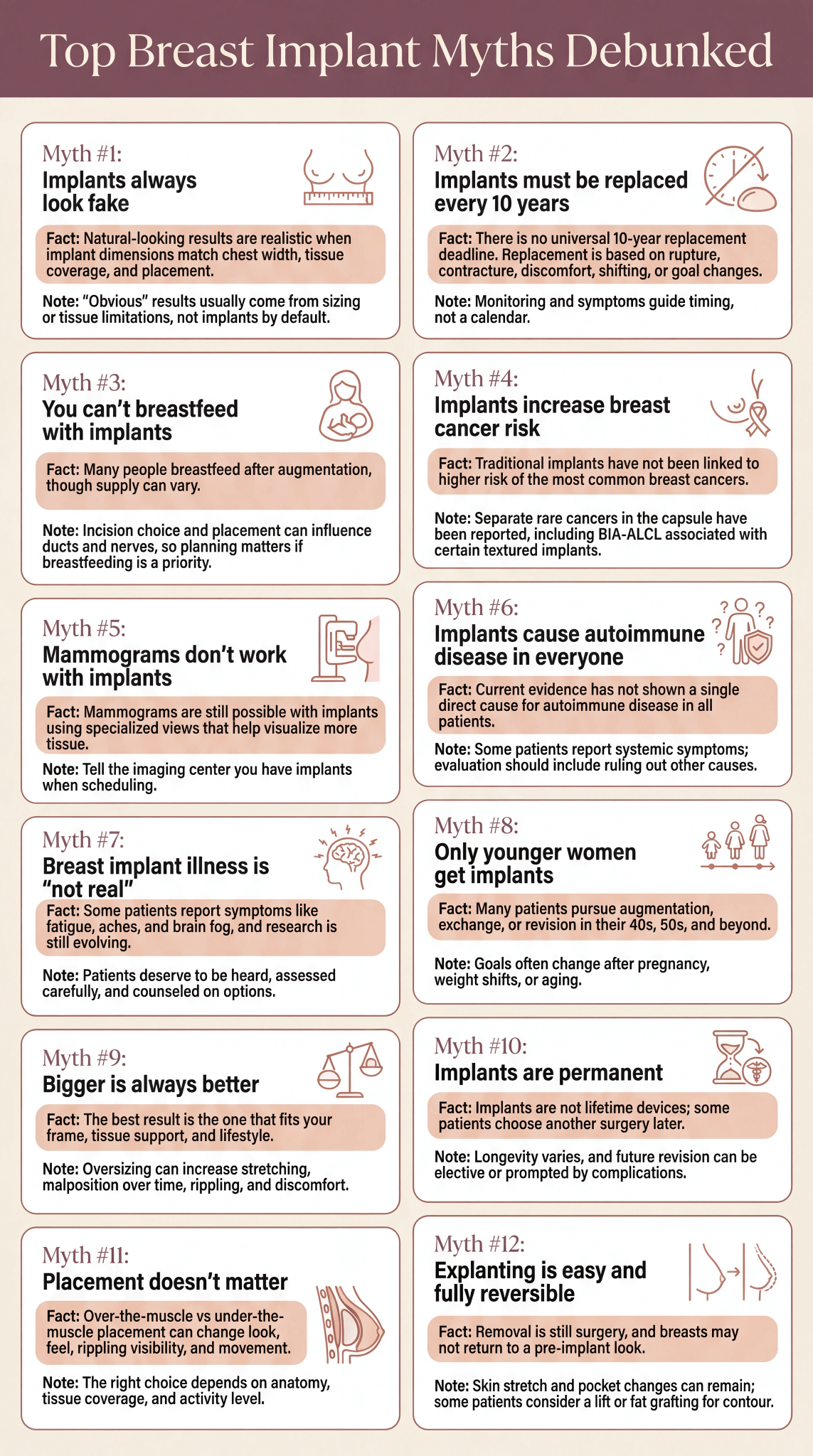
Myth: Implants prevent breastfeeding. Fact: Many people breastfeed after augmentation, though milk supply can vary, so implants do not automatically stop lactation.
Outcomes hinge on surgical choices plus baseline breast tissue.
The CDC notes that implants placed below the muscle usually affect milk production less than those placed above it, and that incisions around the areola can carry a higher risk because they sit near nerves and ducts.
Evidence is mixed, yet encouraging. A PubMed review reported that about 82% of women were able to breastfeed after implants, while some needed supplementation, especially with prior low supply.
If breastfeeding matters to you, talk through placement and incision plans with your surgeon, then document your goals in your surgical plan.
Myth: Breast implants cause breast cancer. Fact: Breast implants have not been linked to a higher risk of common breast cancers, according to the ACS statement.
A separate, much rarer topic involves cancers that can develop in the scar capsule around an implant. BIA-ALCL is a lymphoma, not breast cancer, and it has been associated mainly with certain textured implants, per an FDA Q&A.
The goal is reassurance plus awareness. If you notice a new, persistent change such as swelling or a lump, years after your surgery, a check-in can rule out common causes and keep you on track.
Myth: You cannot get accurate mammograms with implants. Fact: You can, and the imaging team just uses a slightly different approach.
Implants can block parts of breast tissue on standard views. Because of that, many centers take extra images called implant displacement views, which move the implant back and bring more tissue forward so the radiologist can see more clearly.
To make sure you get the right setup, take these steps:
Myth: Implants cause autoimmune disease in everyone. Fact: Current evidence has not shown a single, direct cause for all patients, and many individuals do well long term.
Some patients do report systemic symptoms. The FDA notes that reports have included fatigue, joint or muscle pain, and problems with memory or concentration, and that these reports have been described with different types of breast implants.
In symptomatic patients who chose explantation, Peer-reviewed research found that many reported improvement afterward (81.9% in one systematic review).
If you are experiencing symptoms and trying to decide what to do next, these steps help bring structure and clarity to the process:
At The Practice Healthcare, Dr. Kelly Killeen can walk through what implant removal can and cannot address, as well as how capsule management factors into safety.

Myth: Implants are only for younger women. Fact: Many patients pursue augmentation, revision, or implant exchange in their 40s, 50s, and beyond.
Goals often change with different stages of life, and that is completely normal.
Some patients want to restore volume after pregnancy, while others want to rebalance shape after weight loss or address changes that come with aging. For patients who already have implants, an exchange can also be about comfort, symmetry, or updating a look that no longer feels like you.
What matters most is not your age. It’s your health, your anatomy, and what you want the result to do for your body and lifestyle.
Myth: The best result is always the biggest result. Fact: The best outcome matches your anatomy, looks natural on you, and supports how you want to live day to day.
Bigger implants add more weight, and that extra load can change how your tissues hold up over time. The issue is not “big is bad.” It’s that proportion, support, and long-term comfort matter as much as the initial look, which is why size trends have shifted toward results that stay stable.
Oversizing can increase the chance of:
If you want a fuller look, that can still be part of the plan. The safest path is choosing a volume that matches your chest width and provides adequate tissue support, so the result stays stable and feels good long term.
Myth: One surgery lasts forever. Fact: Many patients enjoy their results for years, but implants are not lifetime devices. Over time, some people decide to exchange, remove, or revise.
That second surgery is not always a “problem.”
Sometimes your goals change. Sometimes pregnancy, weight changes, or normal aging shift breast shape, so the result no longer feels like you. Complications like rupture or capsular tightening can also prompt revision.
A healthier way to plan is to think long-term. Pick options that fit your anatomy now, then protect your outcome with routine follow-ups and smart monitoring. This FDA update explains why implant longevity varies and why additional surgery may be needed over time.
Myth: Placement is a minor detail. Fact: Placement over the muscle vs. under the muscle can change how implants look, feel, and wear over time.
Placement affects how much natural tissue covers the implant and how the edges blend on your frame. It can also influence movement, especially if you train your chest regularly, so it is worth discussing in detail during planning.
Placement can affect:
There is no single “best” choice. The right option matches your anatomy and your goal.
Myth: All implants are basically the same. Fact: Implant options differ in ways that can affect look, feel, incision planning, and long-term maintenance.
Small design details change how volume sits on your frame and how the implant behaves in motion. That is why two people can choose the same “size” and still end up with very different results.
Common differences include:
A thorough consultation walks through why a certain choice fits your body and goals, and what the realistic pros and cons are

Myth: Removal is simple, and you will look exactly like you did before implants. Fact: Explant surgery is still surgery, and your breasts may not return to the pre-implant look.
“Reversible” can be misleading because the body changes over time. Tissue can stretch, skin can loosen, and the implant pocket can shift, especially after pregnancy, weight changes, or years of having implants. After removal, some patients love their natural shape right away.
Others prefer added reshaping, such as a lift or fat grafting, to restore balance and contour.
If you are choosing implants now, it helps to talk through the future too. In a consultation, Dr. Kelly Killeen can explain what removal could look like for your anatomy, what shape changes are realistic, and which reshaping options, like a lift or fat grafting, can support confidence if your goals change later.
“Social platforms tend to reward fast, confident messaging, while medical decisions rely on nuance and context. That contrast can make a dramatic clip feel ‘truer’ than a careful explanation.
That’s why breast implant myths multiply online. A PubMed review of TikTok content on breast implant illness found that anecdotal videos dominated. Higher-quality posts from surgeons did not consistently receive more engagement, even as online ‘authenticity’ is increasingly emphasized in health content.
On social media:
Your lived experience still matters. Use social media to generate questions, then confirm the answers in a consultation that considers your anatomy, implant type, timeline, and symptoms.
When you step away from online noise, clarity tends to follow. You want a look and feel that fits your daily life, an option your anatomy can support safely, and a plan that still makes sense years later.
An ethical consultation should include clear informed-consent steps, including the FDA checklist that reviews risks, benefits, and long-term monitoring.
A strong consult typically covers:

Breast implant myths linger because headlines oversimplify personal decisions. When anatomy, goals, and follow-up planning are considered together, the discussion becomes clearer and more practical.
If the Breast implant illness myth conversation is on your mind, you deserve a space to review symptoms, timelines, and options without pressure. You can also explore procedure details on our Breast Augmentation page and learn about next-step options through Implant Removal / Explant resources.
When you’re ready, schedule a consultation. Your plan should be based on your exam, not a comment thread.
Not always. The “10-year rule” is a myth because timing is not automatic. Most implant exchanges happen for a specific reason, such as rupture, capsular contracture, discomfort, visible changes, or a shift in goals. The breast implant illness conversation works the same way. It benefits from symptom tracking, follow-up, and appropriate imaging, not a date on the calendar.
The Breast implant illness myth label oversimplifies a complex topic. Some patients report fatigue, aches, or brain fog with implants, while research keeps evolving. Many breast implant myths skip the basics: a medical evaluation, labs, and a surgeon consultation to review options.
Yes. Breast implant myths can make screening feel impossible, but mammograms still work. Tell the imaging center you have implants so they can take implant displacement views. The Breast implant illness myth topic is separate, so keep routine screening on schedule.
Often no. Many people breastfeed after augmentation. Breast implant myths overlook that incision choice, implant placement, and your baseline tissue can influence supply. If the Breast implant illness myth debate worries you, discuss long-term plans early so goals stay clear.
Yes. Natural results are realistic when implant dimensions fit your chest width, tissue coverage, and lifestyle. Many implant myths emphasize extremes rather than individualized planning.
Facelift Surgery: The Complete Guide to Modern Techniques, Recovery, and Results
What Is a Chemical Peel and How Does It Improve Your Skin?
How to Prepare for Plastic Surgery: Simple Step-by-Step Guide
Stay in the know with our latest press coverage and helpful content updates to keep you informed.