



Share this post


How long does breast reconstruction take?
From what we’ve seen here at The Practice Healthcare, most timelines land between a few months and about a year, depending on the method and your treatment schedule.
Implant-based reconstruction often takes around 3 to 6 months when done in stages with tissue expanders, while flap reconstruction usually needs more time because you heal at the breast and the donor site.
Even so, the sequence stays predictable. You complete the main surgery, recover, then return for planned steps like expansion, an implant exchange, or contour refinements, coordinated with our team.
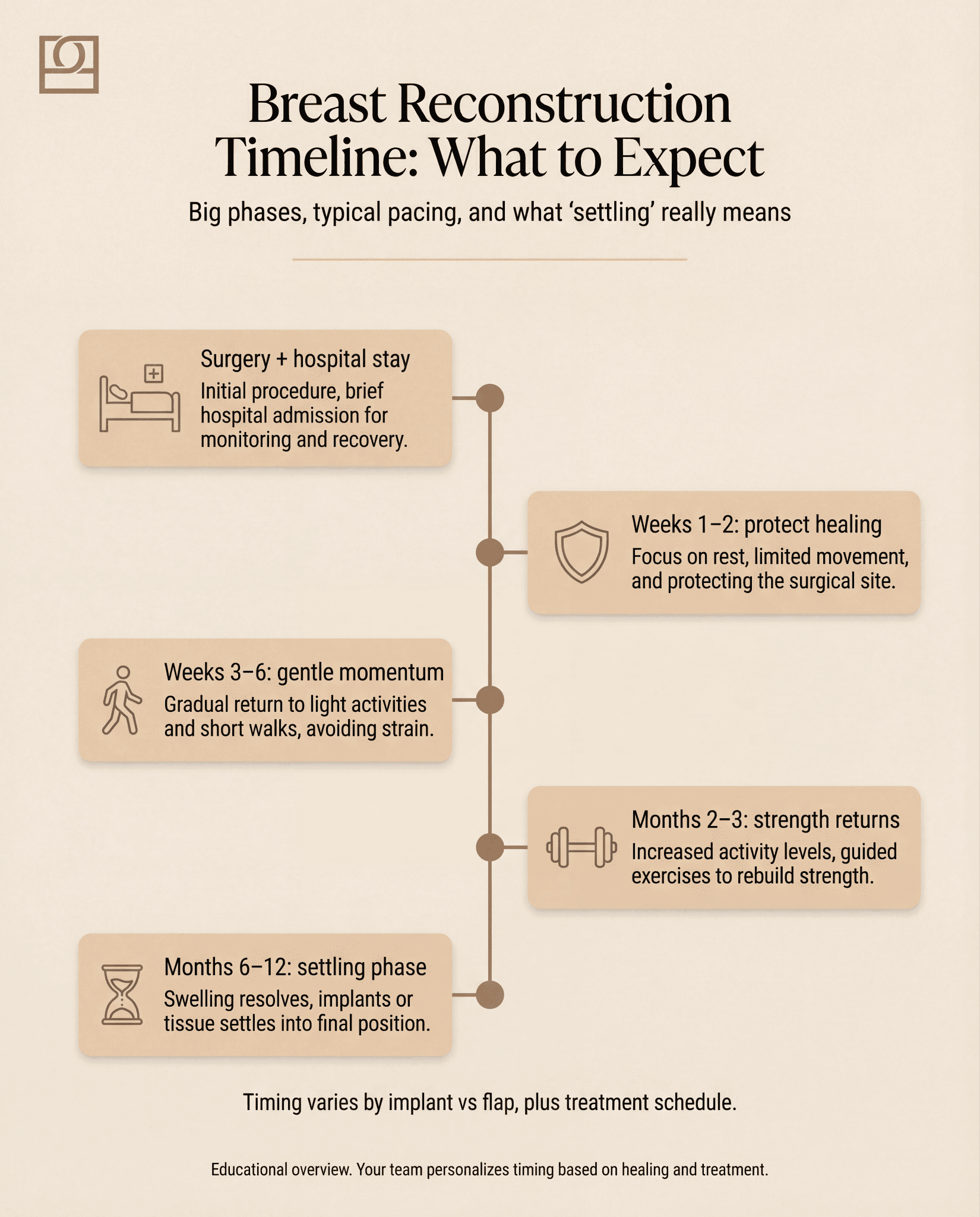
Breast reconstruction rarely happens in a single leap. It usually unfolds in stages, and timing depends on what the body can safely handle between steps.
Several factors set the pace:
Even with the same plan, calendars can differ in practice because swelling, drains, and tissue strength guide the next move. For example, NCI guidance notes that chest tissue is often ready for an implant 2 to 6 months after a tissue expander is placed.
An individualized consultation with Dr. Lisa Cassileth connects these variables into a realistic sequence, including breast procedure timing.
| Topic | Immediate reconstruction (same operation as mastectomy) | Delayed reconstruction (after healing or cancer treatment) |
| When it happens | Begins during the same operation as the mastectomy. | Starts after mastectomy incisions heal and treatment is complete, sometimes months or years later. |
| Why do patients choose it? | Fewer separate surgeries in the early phase, and shaping can begin right away. | Allows time to finish treatment, recover, or make decisions without pressure. |
| Radiation considerations | If radiation is expected, the team may adjust sequencing because radiation can affect healing and reconstructive outcomes. | Often preferred when radiation is planned, since reconstruction may be delayed until radiation ends. |
| Trade-offs to know | Not every treatment plan supports immediate timing, and additional stages may still be needed. | Longer overall calendar to reach a final result, but timing can better protect tissues affected by treatment. |
| How the decision is made | Based on the cancer plan, surgical approach, and tissue factors discussed with the oncology and plastic surgery team. | Based on recovery readiness, treatment completion, and reconstructive options that fit post-treatment tissue quality. |
There are two main categories, and your breast reconstruction timeline will look different depending on which road you take.
| Approach/stage | What happens | Typical timing window |
| Two-stage (tissue expander → implant) | Chosen when skin and tissue need gradual stretching, or when treatment sequencing calls for a staged plan. | The overall process often takes months to finish. |
| Stage 1: Mastectomy + tissue expander placement | An expander is placed during mastectomy, then early healing focuses on incisions, drains, and comfort. | Many patients start about 2 weeks after surgery when healing allows. |
| Stage 2: Expansion visits | Saline fills are done in the clinic to stretch the skin and create space for the implant; visits are often weekly or every other week. | Expansion typically takes 6 to 8 weeks, but it can take longer depending on the size goals and tissue response. |
| Stage 3: Exchange surgery (expander → implant) | The expander is removed and replaced with the permanent implant once the tissue has relaxed and healed. | Chest tissue is often ready 2 to 6 months after expander placement, depending on healing and treatment needs. |
| Direct-to-implant (one-stage) | Permanent implant placed during the same operation as mastectomy, so no expander or second surgery for exchange (in selected candidates). | Hospital stays are often 1 night, and recovery is typically 2 to 4 weeks. |
| Typical recovery ranges (implant pathways) | Expander pathway recovery is often longer than direct-to-implant because expansion and staging add time. | Expander approach recovery is often 4 to 6 weeks, while direct-to-implant is often 2 to 4 weeks (individual variation applies). |
Flap reconstruction uses your own tissue to rebuild the breast. Common examples include DIEP flap, TRAM flap, and latissimus dorsi flap (sometimes combined with an implant).
Patients often prefer flap reconstruction because it can look and feel more natural long-term and avoids the need for a permanent implant. The tradeoff is a more complex surgery and a longer recovery time because you’re healing in two areas.
Mayo Clinic notes that flap reconstruction typically involves a longer hospital stay and a longer recovery than implant reconstruction.
Total time for results to fully settle: often months, and sometimes up to a year as swelling resolves and scars mature, especially if refinement steps are included.

For many patients, nipple and areola reconstruction represents an important stage of the reconstructive process. It often helps the result feel complete, while healing and scar maturation continue in the background.
This step usually comes later. The breast shape needs time to settle first, so nipple position and symmetry are easier to plan. Nipple reconstruction is often scheduled a few months after the main reconstruction, and then areola tattooing follows once the nipple area heals, often several weeks later.
If a surgical nipple step is not the right fit, 3D tattooing alone can be an option.
It avoids an additional procedure and can shorten this part of the breast reconstruction timeline.
Recovery is gradual and occurs in phases rather than all at once.
The American Cancer Society notes that many women start returning to normal activities within 6 to 8 weeks, with implant-only recovery often shorter than flap recovery.
This is the rest-and-heal phase:
This is where you usually notice small wins:
Many patients feel more functional here, but you still want to respect swelling and tissue healing:
This is when scars soften, swelling continues to fade, and shape becomes more predictable.
If you need revisions, this is often the window when they’re discussed and scheduled.
Healing tips that genuinely help:

If your timeline feels complex, ongoing or prior cancer treatment is often a contributing factor.
Radiation can change the reconstruction schedule because it affects skin elasticity and blood supply. Dr. Lisa Cassileth coordinates reconstruction timing with your oncology plan, so the surgical steps support healing rather than hinder it.
As tissue becomes tighter and less predictable, the risk of complications can rise, especially with implant-based plans. For that reason, surgeons often adjust the timing and technique rather than pushing ahead on a fixed date.
ACS notes that if radiation is needed, reconstruction may be delayed until treatment ends.
That delay does not close the door. It protects your long-term outcome, giving tissues time to recover so reconstruction can be planned on stronger, safer ground.
Chemotherapy can affect blood counts and wound healing, so reconstruction timing often follows treatment cycles instead of a fixed calendar. Early healing needs to be stable before treatment ramps up, and that is why surgeons may adjust dates even when the surgical plan stays the same.
According to UCSF FAQ, chemotherapy is often started about 4 to 6 weeks after mastectomy, and the expander-to-implant exchange is commonly scheduled 2 to 3 months after chemotherapy is finished.
That coordination matters, since spacing procedures allows recovery time and lowers avoidable risk while the team keeps the overall sequence moving.
Revisions are common. That’s not a sign of failure. It’s part of how fine results are created, and seeing real revision examples can make the process feel more concrete.
Common refinement options include:
These are often outpatient procedures with shorter recovery, sometimes about 1 to 2 weeks of lighter activity, depending on what’s done. Revisions can add time to your overall breast reconstruction timeline, but they also help ensure the result aligns with your goals.
Emotional recovery often moves on a different timeline than physical healing. You may feel steady for a stretch, then a small trigger can bring a wave of emotion back. That fluctuation is common, and it deserves real support, not pressure to handle it alone.
It’s common to feel:
Support that helps in practice:
At The Practice Healthcare, we coordinate referrals and help you choose options aligned with your needs, alongside our patient advocacy resources.
Breast reconstruction rarely feels like a single finish line. It usually reads as a sequence, with small turning points that add up over time.z
“Done” might mean drains are out and sleep feels normal again. It can also mean daily routines are back, clothes sit the way you expect, and the breast shape stays consistent week to week.
Later, scars soften, swelling fades, and your reflection starts feeling familiar.
So when you ask how long breast reconstruction takes, it helps to name what “done” means personally. For some, it’s returning to work. For others, it’s completing the final refinement step. Both make sense, and the timeline shifts accordingly.

How long does breast reconstruction take? It depends on the type of surgery, the healing pace, and how radiation or chemo fits into the plan.
Even so, most patients move through a breast reconstruction timeline in clear stages: the initial reconstruction, recovery and follow-ups, then planned refinements that support comfort and symmetry.
That structure helps plan time off, childcare, and support at home, because each follow-up confirms healing and sets the next step. At The Practice Healthcare, Dr. Lisa Cassileth coordinates your plan with oncology so you can map the next steps with clear timing and realistic expectations during a consultation.
The operation itself can run about 2 to 10 hours, depending on implants vs a flap. Ask for two estimates: operating-room time and expected hospital stay, since they affect logistics and support at home.
Many patients can have immediate reconstruction during mastectomy, which can reduce separate operations early on. Still, radiation plans, incision patterns, and skin quality may change timing. Your team will map a breast reconstruction timeline that fits treatment and healing.
Early recovery often focuses on rest, drain care, and gentle walking during the first two weeks.
Many people resume light routines within 6 to 8 weeks, while strength, swelling, and scar changes can continue improving for months.
It’s common to need more than one procedure, especially with tissue expanders, since placement and implant exchange happen at different times. Refinements like fat grafting or nipple work may follow. Each step extends the timeline for breast reconstruction.
The best option depends on your anatomy, health, activity goals, and cancer treatment plan. Implants can mean shorter initial surgery, while flaps use your own tissue and involve longer recovery. A consultation should clarify candidacy, risks, and staging.