


Share this post


Most patients ask about weight after the fact, usually when a bra no longer fits properly.
Weight changes after breast reconstruction can affect volume, contour, and symmetry, but a lot rides on how you were reconstructed. Implants stay the size they were made. Flap tissue came from your own body, so it gains and loses right along with you.
If only one side was rebuilt, the other keeps changing on its own, and that mismatch is what people notice first. At The Practice Healthcare, we plan around your weight history from the start. Only your surgeon can tell you what that means for your case.
Weight changes after breast reconstruction still reach your chest. They just show up differently now.
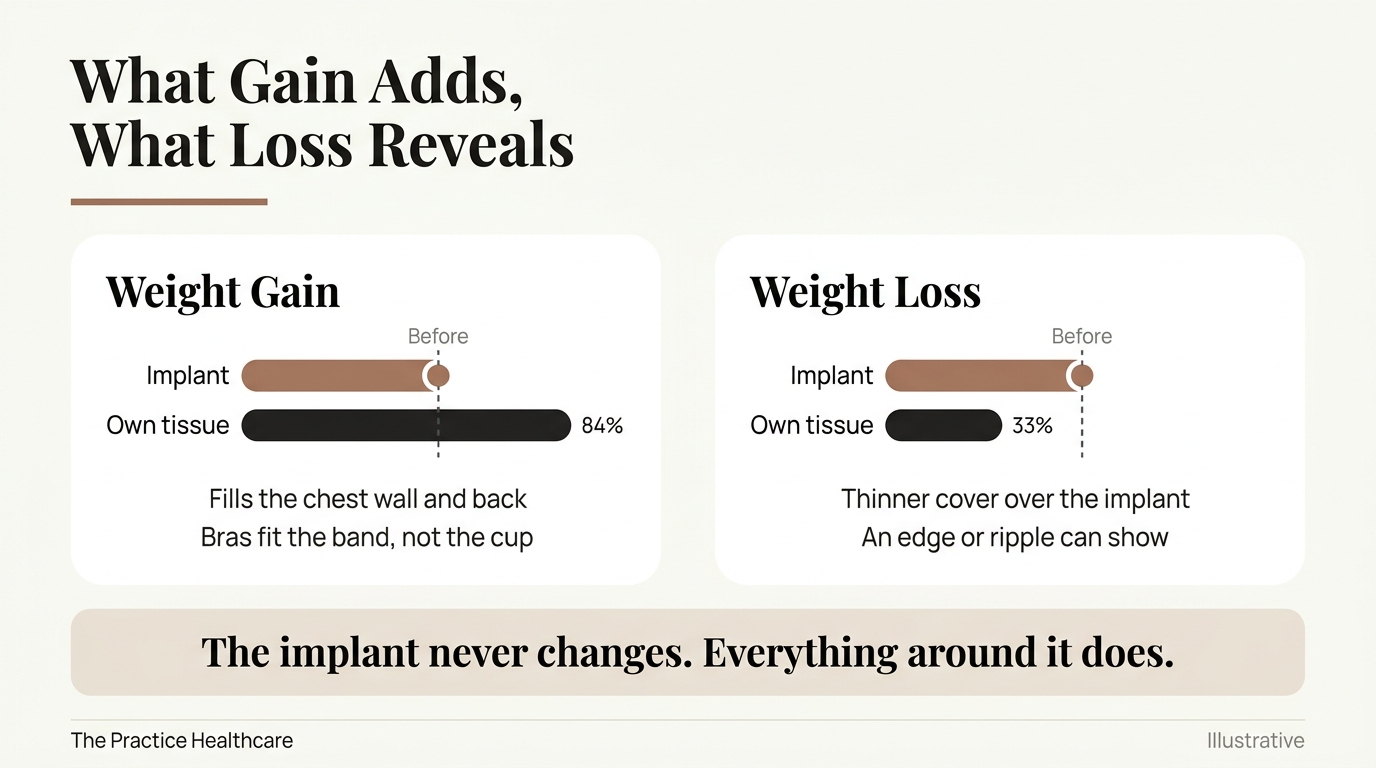
An implant holds one fixed volume, while your natural breast does not. In Eplasty, researchers tracking 123 reconstruction patients found that every woman who lost more than about seven pounds lost volume in her natural breast. So the implant stays, the other side moves, and symmetry drifts.
Flap tissue behaves differently because it came from your abdomen or back and still acts like body fat, so it follows you in both directions.
Weight loss after breast reconstruction adds a second problem, since thinner coverage lets an implant edge or ripple surface. Our reconstruction and revision procedures plan for all of it.
Your body puts fat back where it always has, and it does not care where your surgeon worked.
So weight gain after breast reconstruction fills in the chest wall, the upper back, and your natural breast. A flap gains with you and can grow rounder and heavier. An implant holds its size, so that side looks smaller and sits higher while the natural breast drops.
Your proportions shift too, because fullness returns to the abdomen or back where the flap came from.
What you may notice:
Loss works the other way, and you usually notice it sooner.
Your reconstruction was built for the body you had then. As you get smaller, the fat cushioning your implant goes with it, and mastectomy skin is too thin to soften the shape on its own. So the rim you could not see before shows along the lower border.
Your skin has the same problem in reverse, because it stretches faster than it retracts. Lose quickly, and it hangs loose.
Meanwhile, your natural breast is mostly fat, so it shrinks while the implant holds, and the sides no longer match. Still, weight loss after breast reconstruction rarely ruins breast reconstruction results. Rate matters more than amount.
Yes, but not in the way most patients hope. No technique is immune to weight changes after breast reconstruction. They just move in different places.
| Reconstruction Type | Potential Effect of Weight Changes | Key Consideration |
|---|---|---|
| Implant-based reconstruction | Changes may be more noticeable in surrounding tissues than in the implant itself | Skin and tissue coverage can influence appearance |
| Autologous reconstruction | Transferred tissue can change with overall body-fat changes | Weight fluctuations may alter volume and contour |
| Combined reconstruction | Effects can vary between implant and transferred tissue | Long-term symmetry may require monitoring |
That difference shows up over years. In Plastic and Reconstructive Surgery Global Open, 28 women were tracked for roughly three years, and their breast reconstruction results held as their weight moved, because tissue built from your own body changes when you do.
Reaching that symmetry took revisions, though, and 39% needed work on the natural breast to hold it.
So durability is not a property of the technique. It comes from planning around where your weight is headed. Dr. Lisa Cassileth pioneered one-stage implant reconstruction and performs SWIM flap, so you can weigh both against your own weight history in one consultation.
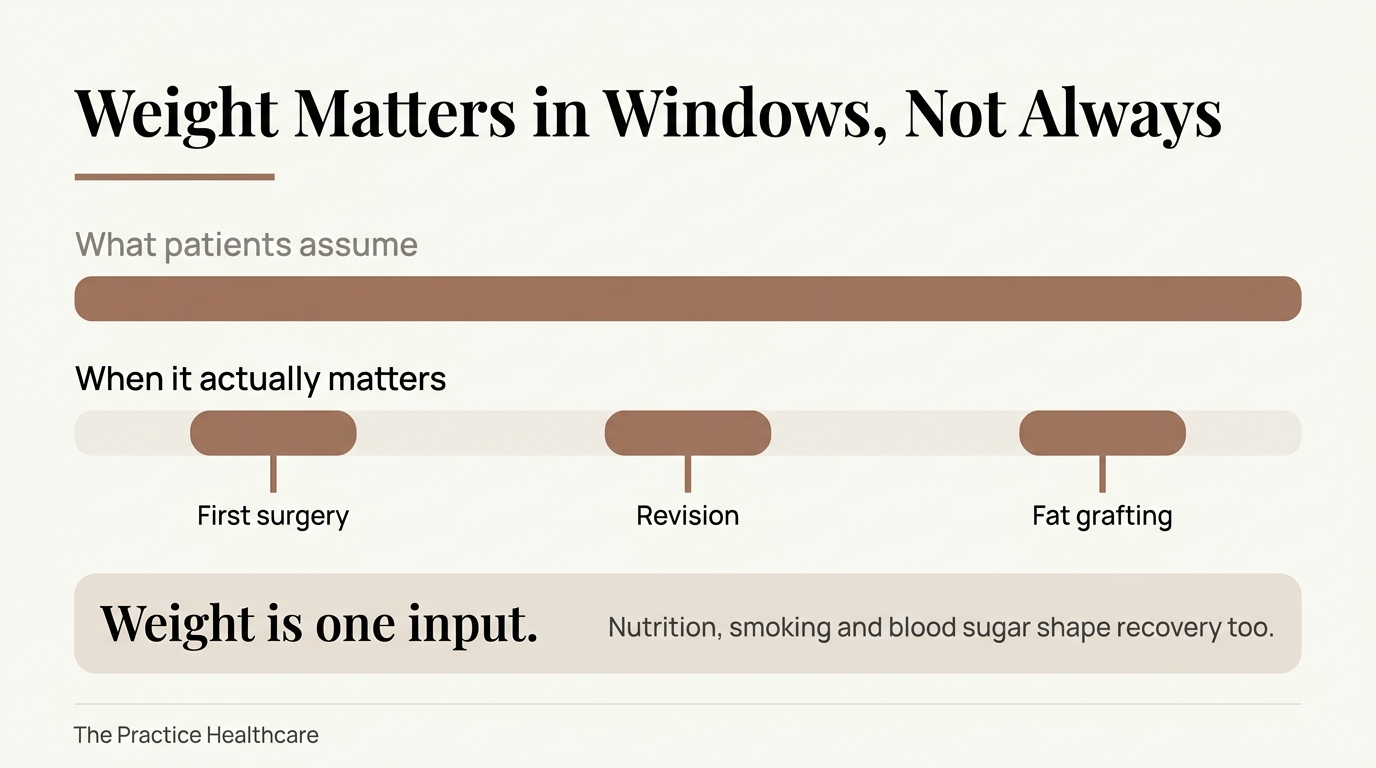
Not always, which is what most patients miss. Weight matters at specific moments.
Safety is one. In Plastic and Reconstructive Surgery, 365 women having abdominal flap reconstruction showed risk climbing in steps, not smoothly. Infections rose above a BMI of 25, while reoperation and tissue loss held until 35.
So your surgeon can name a target instead of saying lose weight.
Predictability is the other, and it sets the timing:
Weight is one input, though. Nutrition, smoking, and blood sugar shape your breast reconstruction recovery too, which is easier to manage when surgery and aftercare share one location.
Yes, and speed decides which one you get.
Lose it gradually, and your skin keeps up. Your frame narrows, your back and shoulders carry less, and the reconstruction often reads beautifullybetter against a slimmer body.
Lose it fast, and your skin never gets the chance. That is why women on GLP-1 medications or coming off bariatric surgery see their chest, abdomen, and arms change together, with laxity and visible implant edges arriving as a set.
So sequence matters more than the number on the scale. Tell your surgeon before you start, because that is when weight loss after breast reconstruction can still be planned around, whether by revising later or adding body contouring once you reach your goal.

Steadiness beats optimizing. Settling five pounds heavier and staying there is easier on your skin than losing and regaining it twice, because skin stretches faster than it recovers.
Three habits actually matter:
That timeline is the point. What suits you at nine months will hurt you at four weeks, so ask before starting any diet or training program during breast reconstruction recovery.
Call sooner than you think you need to.
A change that looks cosmetic is not always cosmetic. Rippling or a shifting contour can also mean capsular contracture, fat necrosis, or a fluid collection, and a mirror cannot tell you which.
Worth calling about:
Caught early, most of this is reassurance or a minor revision. Left alone, your breast reconstruction results are harder to correct. Dr. Lisa Cassileth has spent over twenty years on reconstruction and revision, so book a consultation rather than guessing.
Usually, yes. Revision is how breast reconstruction results are maintained, not proof that anything failed.
What your surgeon suggests depends on what changed. Thin tissue over an implant often means fat grafting. A size mismatch usually means implant exchange or work on your natural breast. Loose skin means a lift.
Knowing which one applies takes an exam, not a photo. Dr. Lisa Cassileth performs both the original reconstruction and the revision, so nothing gets lost between the two.
Coverage is worth raising early, because the Women's Health and Cancer Rights Act requires plans covering mastectomy to cover reconstruction and symmetry surgery, though Medicare, Medicaid, and some self-funded plans sit outside it. Our insurance team can tell you where yours lands.
How much you notice depends less on the scale than on what your own tissue can absorb. Thicker coverage hides a ten-pound change that thin skin would reveal.
| Situation | What happens | What to do |
| Under roughly 10 pounds | Usually invisible, especially with good coverage | Note it, no action needed |
| Significant loss | Thinner coverage lets implant edges and rippling surface | Get seen before laxity settles |
| Significant gain | Chest, back, and natural breast grow while an implant holds | Ask whether exchange or grafting fits |
| Planned loss, including GLP-1s | Predictable, so it can be worked into your plan | Tell your surgeon before you start |
| New change at a stable weight | May not be weight at all | Have it examined |
Two women with the same surgeon and the same twelve-pound loss can look completely different, because one had radiation and the other has thicker skin over her implant. Neither outcome is a failure.
So weight changes after breast reconstruction are worth discussing with your own surgeon, since someone else's experience predicts nothing about yours.

If yes, that is the conversation to have now rather than later. An implant holds its size while your body shifts around it, and your own tissue shifts with you. Neither is a flaw, and both are manageable with the right support.
Protecting your breast reconstruction results comes down to timing.
At The Practice, Dr. Lisa Cassileth leads reconstruction and revision, and she developed the Direct-to-Implant and SWIM flap techniques now used worldwide. Book a consultation and bring your plan.
No. Your natural breast is mostly fat, so it grows and shrinks with you, while an implant holds one fixed size. That difference is why weight movement shows up as asymmetry after one-sided reconstruction.
Reconstruction built from your own tissue follows your weight more closely than an implant does.
There is no universal threshold, but most surgeons want to hear about movement past roughly 10% of your body weight. Weight gain after breast reconstruction usually settles in your chest wall, back, and natural breast rather than the reconstructed side, which is what creates a visible mismatch.
Yes, and many surgeons prefer you reach a stable weight first, since it makes sizing more predictable and can lower complication risk. Timing is the complication, especially when cancer treatment is already scheduled.
Raise any planned loss with both your oncology and reconstructive teams before starting.
Most surgeons want the acute phase of breast reconstruction recovery finished first, usually six to eight weeks, because healing tissue needs calories and protein rather than a deficit. Losing weight before then can compromise wound healing. Ask your surgeon for a timeline matched to your procedure.
Yes, once your surgeon clears you, though chest and overhead work is cleared last.
Subpectoral implants deserve extra caution, since the muscle contracting over them can visibly shift position. Rebuild gradually rather than returning to your previous loads, and report any new distortion or contour change.
Yes. Pregnancy alters breast volume, skin elasticity, and symmetry, and it affects a natural breast differently than a reconstructed one.
Abdominal flap reconstruction adds considerations, because donor tissue has already been taken from your abdomen. Mention any pregnancy plans during reconstruction planning, not afterward.
Yes. Weight loss after breast reconstruction is commonly addressed with fat grafting to restore coverage, implant exchange, skin tightening, or a balancing procedure on your natural breast.
What suits you depends on your original technique and tissue quality. Revision is routine maintenance, not evidence of failure.