


Share this post


Choosing between breast augmentation vs breast lift is one of the most common and most misunderstood decisions in cosmetic breast surgery. Both procedures improve the appearance of the breast, yet they target completely different concerns.
One adds volume. The other restores the position.
Breast augmentation is about size and fullness. A breast lift is about shape and placement. That distinction shapes your surgical plan, your recovery, and the results you can realistically expect.
At The Practice Healthcare in Beverly Hills, Dr. Kelly Killeen evaluates anatomy and goals to recommend the right procedure or a combination of both.
Breast augmentation, or augmentation mammoplasty, increases breast size and improves shape using implants or fat transfer. It consistently ranks among the most performed cosmetic surgeries in the U.S.
According to the American Society of Plastic Surgeons, it ranked second in 2024, behind only liposuction.
The procedure addresses volume, not position. It will not lift sagging tissue or reposition the nipple. If your concern is size and fullness, breast augmentation delivers. If it’s where your breast sits on the chest wall, you need a different approach entirely.
Dr. Kelly Killeen tailors each augmentation plan to your anatomy for proportionate, natural-looking results.
When it comes to fill type, you have two primary choices: silicone gel and saline. Silicone closely mimics natural tissue, while saline allows for volume adjustment during surgery. For most patients, silicone is the preferred option.
Shape and placement matter just as much. Both directly influence how your results look and feel:
For patients who prefer to avoid implants altogether, fat transfer augmentation offers a natural alternative, adding up to one cup size using your own harvested fat.
Understanding what breast augmentation actually delivers helps you go into your consultation with realistic expectations.
It solves specific problems well. Others fall outside the procedure's intended scope.
Breast augmentation can:
What it cannot do is equally important to know:
A breast lift, medically known as mastopexy, raises and reshapes sagging breasts by removing excess skin and tightening the surrounding breast tissue. It repositions the nipple-areola complex to a more youthful, anatomically appropriate location on the chest wall. It does not significantly increase breast size.
Mastopexy is the right procedure when the concern is position, not volume.
Many patients with adequate breast size but noticeable sagging find that augmentation alone leaves them unsatisfied, because it adds mass without correcting where the breast and nipple sit on the chest.
Common reasons patients seek a breast lift include post-pregnancy sagging, age-related ptosis, weight fluctuation, or nipples that sit at or below the breast crease.
A 2023 JPRAS systematic review confirmed the Regnault classification as the most widely used framework for staging breast ptosis. That matters because sagging presents differently in every patient, and the degree of ptosis determines which mastopexy technique fits your anatomy.
The technique your surgeon uses depends on the degree of sagging and your anatomy. Each approach is matched to a specific degree of ptosis:
A breast lift works on structure, not size. Understanding that distinction before your consultation helps you avoid setting expectations that the procedure was never designed to meet.
A breast lift can:
That said, there are real limits:

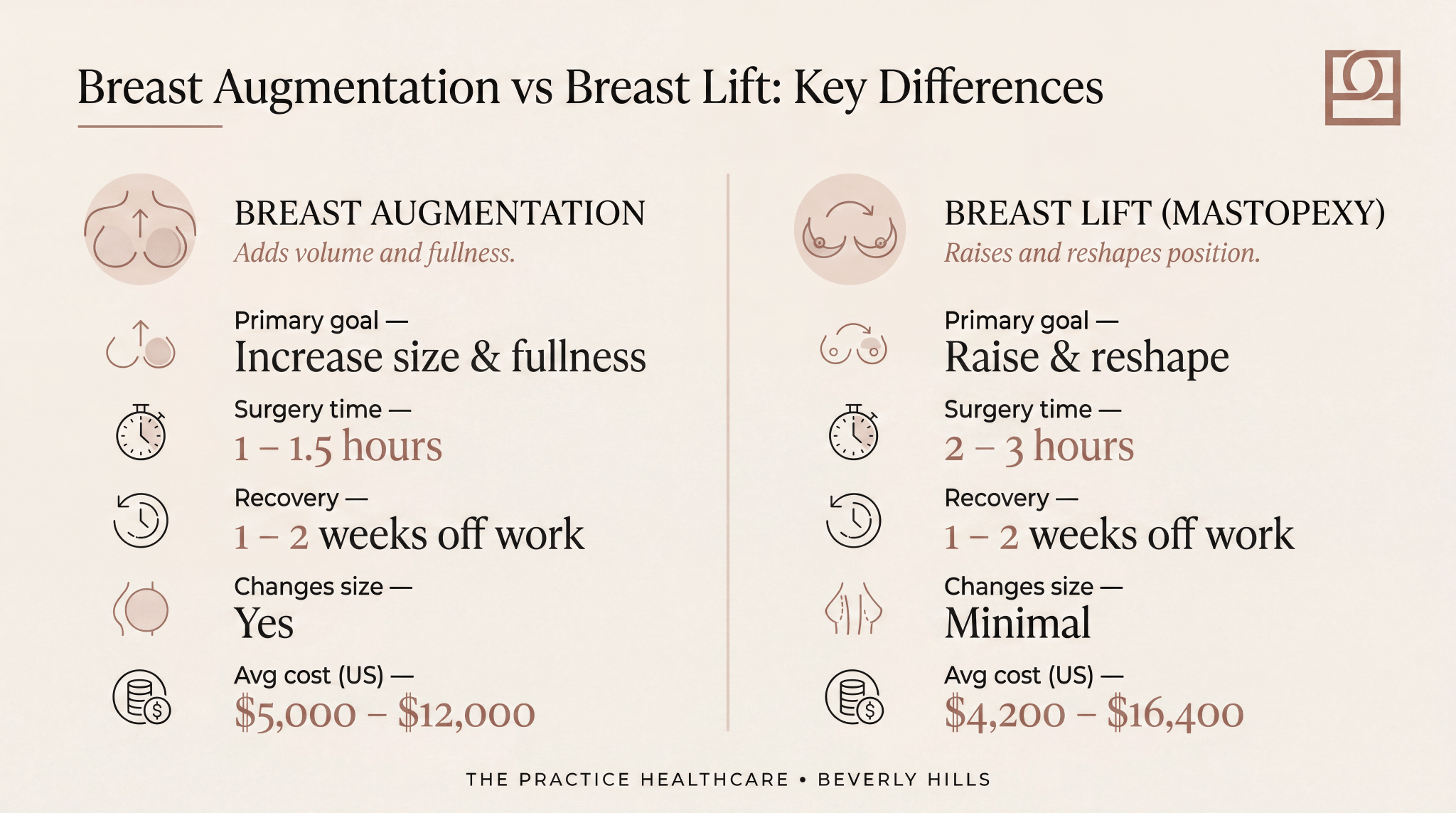
Putting breast augmentation vs breast lift side by side clarifies the decision.
| Breast Augmentation | Breast Lift (Mastopexy) | |
| Primary goal | Increase size and fullness | Raise and reshape position |
| What it treats | Volume loss, small size, asymmetry | Sagging, ptosis, nipple descent |
| Implant required? | Yes (or fat transfer) | No |
| Changes size? | Yes | Minimal |
| Surgery time | 1 to 1.5 hours | 2 to 3 hours |
| Recovery | 1–2 weeks off work | 1–2 weeks off work |
| Average cost (US) | $5,000 – $12,000 | $4,200 – $16,400 |
Breast augmentation delivers a fuller, more projected silhouette with enhanced upper-pole volume. A breast lift delivers a higher breast position with the nipple properly repositioned on the chest wall.
Both procedures improve appearance, but they solve different problems. Your goal is what determines which one is right for you.
Most patients who want their pre-pregnancy breasts back find that both volume and position have changed over time. Volume loss calls for augmentation. Positional change calls for a lift. When both have changed, augmentation mastopexy addresses them together in a single surgery.
Breast augmentation is the most straightforward of the three.
Your surgeon makes a small incision, either at the breast crease, around the areola, or in the armpit, places the implant, and closes. The procedure typically takes 1 to 1.5 hours.
A breast lift is more involved and takes longer, typically 2 to 3 hours. That extra time accounts for removing excess skin, reshaping the breast tissue, and repositioning the nipple-areola complex before the incisions are closed.
Combining both procedures into one surgery requires the most time and technical precision. Because two separate goals are being addressed at once, the planning and execution are more complex than either procedure performed alone.
Both procedures follow a similar recovery arc. Most patients return to light activity within one to two weeks, with strenuous exercise restricted for four to six weeks.
After augmentation, implants gradually settle into their final position over three to six months as surrounding tissue adapts. After a breast lift, swelling clears within two to four weeks, though scars continue maturing for up to 18 months.
Combining both means one surgery and one recovery period instead of two.
Breast augmentation typically costs between $5,000 and $12,000 in the U.S., while a breast lift ranges from $4,200 to $16,400, with a national median around $9,122. Both figures vary based on surgeon experience, technique, and location.
In Beverly Hills, costs run higher than the national average.
Combining both into one surgery is generally more economical than two separate procedures. One anesthesia fee, one facility charge, and one recovery period add up to real savings for patients who need both.
Yes. Performing both together is called augmentation mastopexy, one of the most requested combinations in cosmetic breast surgery. It suits patients needing both volume and repositioning after pregnancy, weight loss, or aging.
One surgery means one recovery and a lower overall cost than two separate procedures.
The American Society of Plastic Surgeons confirms that with careful patient selection and a well-planned surgical approach, augmentation mastopexy can be performed safely with acceptable outcomes. Patients overwhelmingly prefer it over staged surgery for exactly that reason.
Not every patient qualifies. Ptosis severity, skin quality, and implant size all determine whether a single-stage approach is right for you.
The clearest way to approach this decision is to match your concern to the procedure designed to solve it.
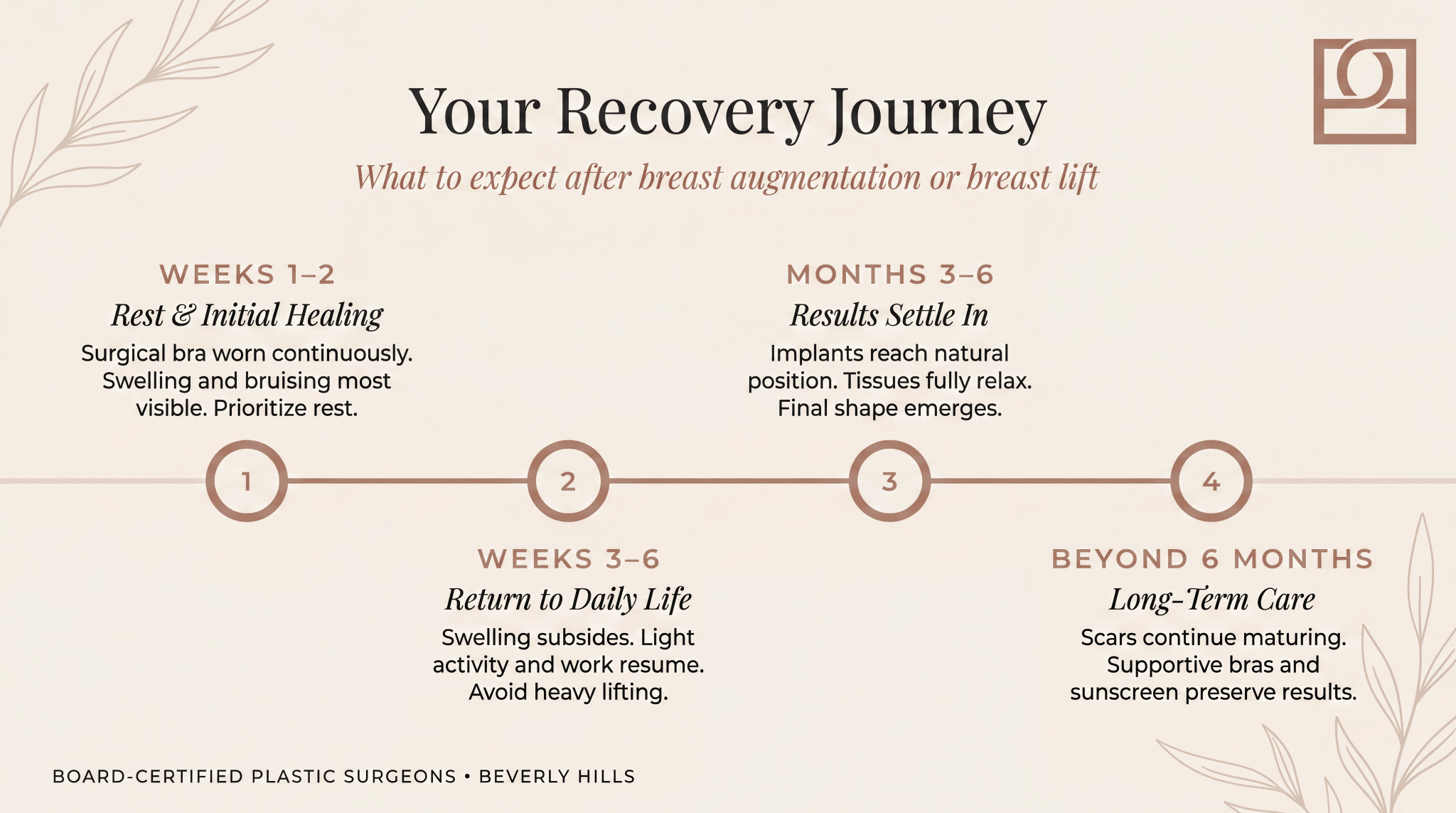
| Phase | What’s Happening | What to Avoid |
| Weeks 1 to 2 | Swelling and bruising are most visible. A surgical bra is worn continuously. Rest is the priority. | Lifting, overhead reaching, and any strenuous activity |
| Weeks 3 to 6 | Swelling gradually subsides. Most patients return to light work and daily activity. | Exercise and heavy lifting |
| Months 3 to 6 | Final results become visible as tissues fully settle. Implants reach their resting position. Scars continue maturing but become less noticeable with proper care. | No major restrictions |
The decision between breast augmentation vs breast lift comes down to your anatomy, your goals, and what a hands-on assessment reveals. There is no universal answer.
That is why a personalized consultation matters. Come prepared with reference photos that reflect your aesthetic goals, a clear account of your surgical history, and specific questions about recovery and scarring.
That preparation makes the conversation more focused and productive for both of you.
Dr. Kelly Killeen and the team at The Practice Healthcare evaluate each patient individually, assessing tissue quality, ptosis degree, skin laxity, and volume needs. The breast procedures offered span augmentation, lift, reconstruction, and revision, so whatever your anatomy requires, the right approach is available.
The Practice Healthcare is a physician-led group in Beverly Hills that performs breast augmentation, breast lift, reconstruction, and revision under one roof.
Dr. Kelly Killeen is a double board-certified plastic surgeon known for her expertise in breast augmentation, breast lift, complex breast revision, and reconstruction.
A nationally recognized specialist featured on Dr. 90210 and cited by The New York Times, Wall Street Journal, and Good Morning America, she brings anatomy-driven precision and a patient-centered approach to every surgical plan at The Practice Healthcare.
Meet the board-certified plastic surgeons behind your procedure and schedule a consultation for a direct, honest assessment.

Breast augmentation adds volume. A breast lift corrects the position. A combined augmentation mastopexy addresses both. The right answer starts with your anatomy, not a preference.
That said, whoever performs your procedure shapes the outcome. At The Practice Healthcare, Dr. Kelly Killeen and a team of board-certified surgeons evaluate your anatomy directly, build a plan around your goals, and give you an honest recommendation before you commit to anything.
Breast augmentation increases size and fullness using implants or fat transfer.
A breast lift raises sagging tissue and repositions the nipple without adding volume. Breast augmentation vs breast lift is not a choice between better or worse. It is a choice between volume and position. Many patients benefit from both procedures combined in a single surgery.
Breast augmentation adds volume but does not correct sagging or reposition a nipple that has descended. In breasts with significant ptosis, implants can make drooping more visible.
Patients with both volume loss and sagging are better candidates for augmentation mastopexy, which addresses both concerns in one surgery with one recovery period.
Yes. Combining both is safe for appropriately selected patients and has a strong clinical track record.
An experienced, board-certified surgeon and careful patient selection are what make combined augmentation mastopexy consistently produce satisfying outcomes. Patients who are not suitable candidates may be advised to stage the procedures separately.
Both deliver long-lasting but not permanent results. A breast lift lasts for many years with stable weight and proper support. Implants are not lifetime devices, and most patients consider revision within 10 to 20 years.
Stable weight, consistent follow-up, and sun protection for scars significantly extend your results.
The pencil test offers a practical first clue. Place a pencil beneath your breast.
If it holds, sagging is likely significant, and a breast lift is probably part of your plan. If not, breast augmentation alone may address your goals.
A consultation with a board-certified surgeon is the only way to get a precise answer.