


Share this post


Loose skin develops when collagen and elastin break down faster than the body can replace them. Weight loss, pregnancy, aging, and hormonal decline all accelerate that process at different rates and in different tissue layers.
The degree of laxity determines which treatments will produce meaningful results. Mild to moderate cases respond well to energy-based and collagen-stimulating treatments, making skin tightening without surgery a viable option for many patients.
Severe laxity typically requires a surgical approach.
At The Practice Healthcare, Dr. Beina Azadgoli evaluates each patient’s skin quality and laxity severity before recommending a course of action.
Skin laxity develops when collagen and elastin production decline faster than the body can replace them. Several factors drive that process:
Hormonal changes compound these factors. Estrogen decline during perimenopause and menopause accelerates dermal collagen loss, which explains the notable shift in skin firmness many women experience in their 40s and 50s.
Severity determines which treatments will actually work for you. Dr. Beina Azadgoli evaluates laxity across a spectrum before making any recommendations.
Non-surgical treatments stimulate collagen and improve firmness. They cannot remove excess skin, so severe laxity usually requires a surgical approach.
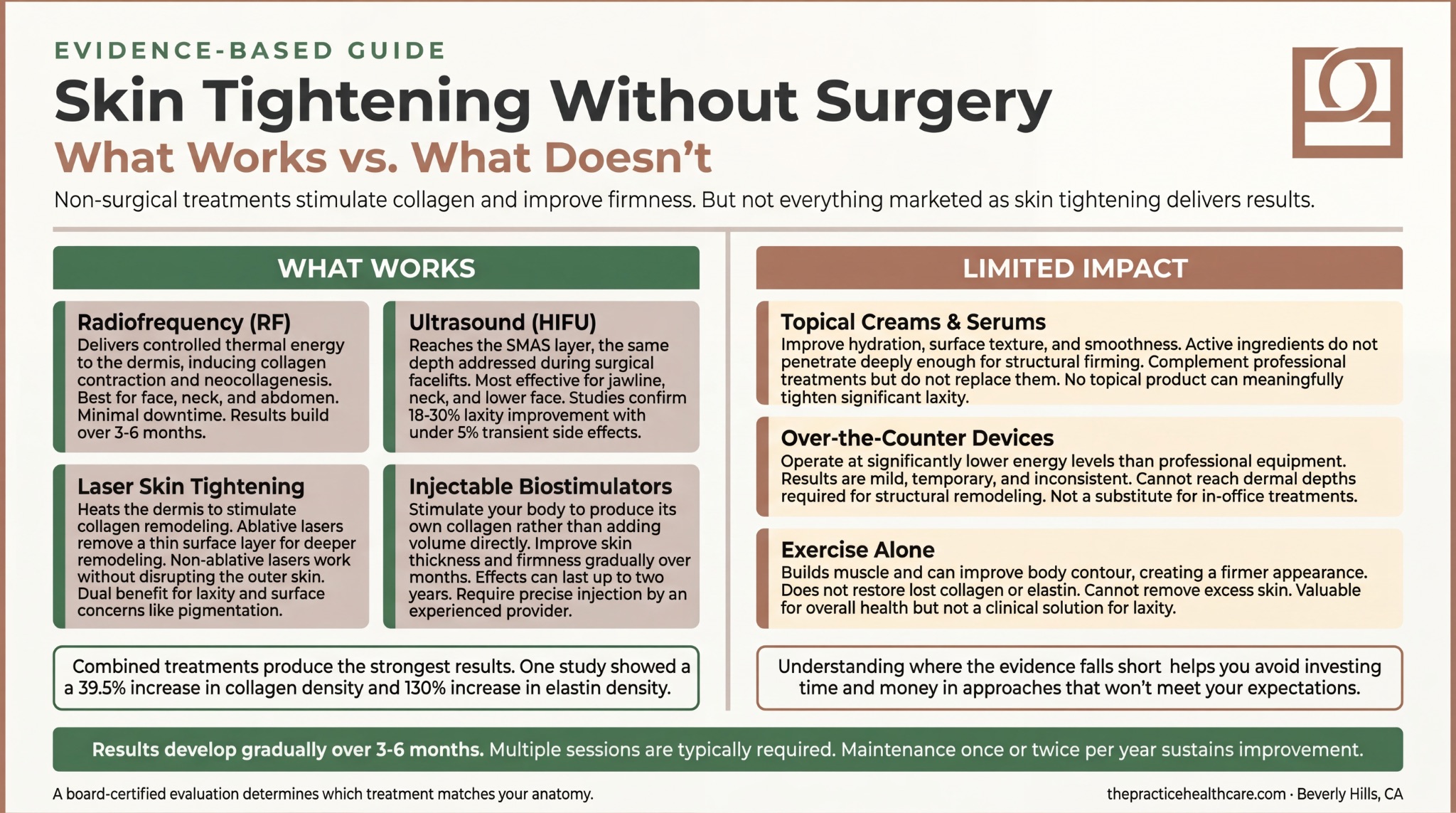
Skin tightening without surgery is clinically viable for mild-to-moderate laxity. Non-surgical treatments stimulate collagen production, improve dermal firmness, and produce measurable structural changes when applied to the appropriate tissue depth.
For severe laxity or significant excess skin, non-surgical options improve texture and quality but cannot replicate the outcome of surgical tissue removal.
Results develop gradually over weeks to months as new collagen matures. A study in Skin Research and Technology confirmed that combined energy-based treatments produced measurable dermal remodeling, including a 39.53 percent increase in collagen density and a 130.04 percent increase in elastin density.
All non-surgical skin-tightening treatments share one underlying mechanism: controlled thermal energy delivered to specific skin layers, triggering a wound-healing response that stimulates the production of new collagen and elastin.
The immediate effect is a mild contraction of collagen, which produces subtle tightening.
The more significant improvement develops over three to six months as your body generates new collagen, which firms the treated tissue from within.
Because each session builds on the previous one, multiple treatments are typically required. Maintenance sessions help sustain your results as the natural aging process continues.
Several categories of non-surgical treatment have accumulated enough clinical evidence to be considered effective for skin tightening.
Each works through a different mechanism and targets different tissue depths, so the right choice depends on your anatomy, your degree of laxity, and what you are trying to achieve. Treatment selection should always be guided by a qualified provider.
Radiofrequency treatments deliver controlled thermal energy to the dermal layer, inducing collagen contraction and stimulating neocollagenesis over time. RF is one of the most extensively studied non-surgical skin tightening modalities, commonly applied to the face, neck, and abdomen.
Improvement builds gradually over three to six months, and a series of sessions is typically recommended for optimal outcomes.
Downtime is minimal, making RF well-suited for mild to moderate laxity.
Understanding how RF fits within a broader nonsurgical facial rejuvenation strategy helps you make more informed decisions about your treatment plan.
Ultrasound-based treatments target deeper tissue layers than most non-surgical options, reaching the superficial muscular aponeurotic system (SMAS), the same layer addressed during surgical facelifts.
That depth makes it particularly effective for the jawline, neck, and lower face.
A 2025 systematic review in the Aesthetic Surgery Journal confirmed that high-intensity focused ultrasound produced skin laxity improvements of 18 to 30% across treated areas, with fewer than 5 percent of patients reporting transient side effects.
Collagen remodeling continues progressively for several months after each session.
Laser treatments heat the dermis to stimulate collagen remodeling while improving skin tone and texture. Ablative lasers remove a thin surface layer to trigger deeper remodeling.
Non-ablative lasers heat the tissue without disrupting the outer skin.
That distinction matters for your treatment plan. If you are managing both laxity and surface concerns like uneven pigmentation or textural irregularities, laser offers a dual benefit that neither RF nor ultrasound alone can provide.
Unlike traditional fillers, injectable biostimulators do not add volume directly.
Instead, they stimulate your body to produce its own collagen, improving skin thickness and firmness gradually over several months. Effects can last up to two years in some patients.
Because these treatments require precise injection into specific tissue planes, provider expertise is critical. Dr. Beina Azadgoli evaluates each patient’s skin quality and structural needs to determine whether biostimulators are an appropriate addition to your treatment plan.

Understanding where the evidence falls short helps you avoid investing time and money in approaches that will not meet your expectations.
Topical products can improve skin hydration, surface texture, and smoothness. Retinol and retinoid-based formulations support collagen synthesis with consistent use, though their active ingredients do not penetrate deeply enough to produce the structural changes required for visible firming.
So while these products have a role in your skincare routine, they complement professional treatments rather than replace them. No topical cream or serum can meaningfully tighten significant skin laxity at the dermal level.
At-home radiofrequency and microcurrent devices operate at significantly lower energy levels than professional-grade equipment. They can offer subtle improvements in texture, but results are mild, temporary, and vary consistently across brands.
That energy gap is clinically significant. Because these devices cannot reach the dermal depths required for structural remodeling, they should not be considered a substitute for in-office treatments performed by a trained provider.
Regular exercise builds muscle and can improve body contour, creating a firmer appearance in some areas.
However, it does not restore lost collagen or elastin or remove excess skin.
Exercise is a valuable component of overall health and supports your outcomes after both surgical and non-surgical treatments. On its own, though, it is not a clinically effective solution for skin laxity.
Non-surgical treatments have clear boundaries, and recognizing them is part of responsible care. Surgery is typically the more appropriate path when you are dealing with:
Procedures like a tummy tuck or a deep plane facelift remove redundant tissue directly.
Dr. Beina Azadgoli evaluates both surgical and non-surgical options to ensure your recommendation is based on what will actually produce the outcome you want.
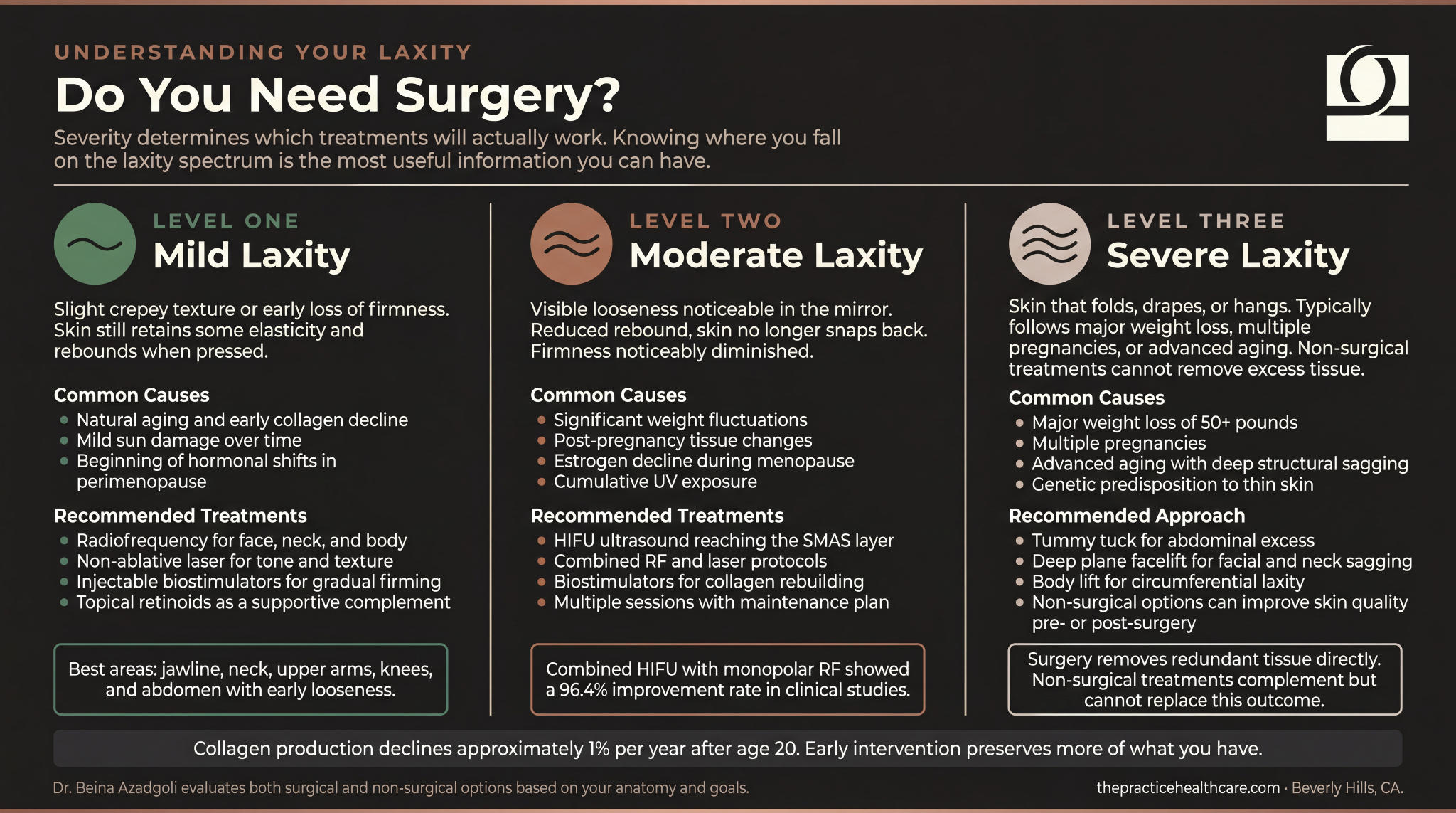
Non-surgical skin tightening produces the strongest results where laxity is mild to moderate, and the skin retains baseline elasticity. Tissue thickness, blood supply, and underlying structural support all determine how effectively your skin rebuilds collagen in response to treatment.
The areas that tend to respond most consistently include:
Non-surgical skin tightening produces real, measurable improvement, though the degree of change depends on the severity of your laxity your laxity severity and the treatment protocol selected.
You can generally expect:
A retrospective study in the Malaysian Journal of Medical Sciences confirmed that combining HIFU with monopolar RF produced a 96.4% improvement rate with a favorable safety profile, reinforcing that protocol selection directly influences your outcome.
Non-surgical skin tightening results typically last one to two years, though longevity varies by treatment modality, the area treated, and your individual skin biology.
Collagen production continues to decline with age, so maintenance sessions once or twice per year help sustain the structural improvements from your initial series. Sun protection, adequate protein intake, hydration, and avoiding smoking all help your results last longer.
Ongoing care matters just as much as the treatment itself. How your medical team optimizes post-treatment recovery directly shapes how well skin tightening without surgery performs over time.
The most suitable candidates for non-surgical skin tightening share several clinical characteristics:
If you have significant excess skin, a surgical approach will be more appropriate. Dr. Beina Azadgoli evaluates your skin quality, laxity severity, and health profile before recommending a course of action.

Non-surgical skin tightening delivers measurable results for the right candidate.
Knowing where you fall on the laxity spectrum is the most useful information you can have before making any treatment decision.
Dr. Beina Azadgoli at The Practice Healthcare evaluates both surgical and non-surgical options to ensure your recommendation is grounded in your anatomy and goals. Contact us to schedule your consultation.
Can loose skin be tightened without surgery after weight loss? It depends on severity. Mild-to-moderate laxity responds well to radiofrequency, ultrasound, or biostimulators. Severe cases with hanging or folding skin typically require surgical intervention, such as a body lift or tummy tuck.
Most skin tightening without surgery produces a sensation of warmth or mild discomfort. Radiofrequency and ultrasound deliver controlled heat to deeper tissue layers. Topical numbing agents are available, and energy levels are adjusted throughout the session based on your comfort.
Most non-surgical skin-tightening treatment plans involve three to six sessions spaced several weeks apart, followed by maintenance once or twice per year. Session count varies by device, treatment area, and degree of laxity. A personalized evaluation determines the most appropriate protocol for you.
Skin tightening without surgery is considered safe when performed by trained providers using professional-grade equipment. The most common side effect is transient redness resolving within hours. Serious complications are rare. At-home devices carry a higher risk profile due to lower energy levels and a lack of clinical oversight.
There is no fixed age. Some patients begin skin tightening without surgery in their 30s to address early collagen loss, while others start in their 40s or 50s. Skin condition matters more than age. A provider evaluation determines the most appropriate timeline for you.
Facelift Surgery: The Complete Guide to Modern Techniques, Recovery, and Results
What Is a Chemical Peel and How Does It Improve Your Skin?
How to Prepare for Plastic Surgery: Simple Step-by-Step Guide
Stay in the know with our latest press coverage and helpful content updates to keep you informed.