



Share this post


How often can you get Botox? It depends on more than just a calendar interval.
Botox works by temporarily blocking nerve signals to targeted muscles. Over time, with consistent treatment, those muscles weaken gradually, which means many patients need fewer units and less frequent sessions to maintain results.
At The Practice Healthcare, Dr. Omar Hussain tailors every Botox plan to your anatomy, metabolism, and aesthetic goals, because the right schedule looks different for everyone.
Botox works by temporarily blocking nerve signals at the neuromuscular junction, preventing targeted facial muscles from contracting. As those muscles relax, the dynamic wrinkles they produce, including forehead lines, frown lines, and crow’s feet, soften and become less visible.
A review in the Journal of Clinical Medicine confirms that botulinum toxin inhibits acetylcholine release at the presynaptic nerve terminal, which is what stops the contraction signal. Over time, your body regenerates those nerve endings, restoring muscle activity and gradually fading results.
Understanding how Botox fits within your broader nonsurgical rejuvenation plan helps you approach maintenance more strategically.
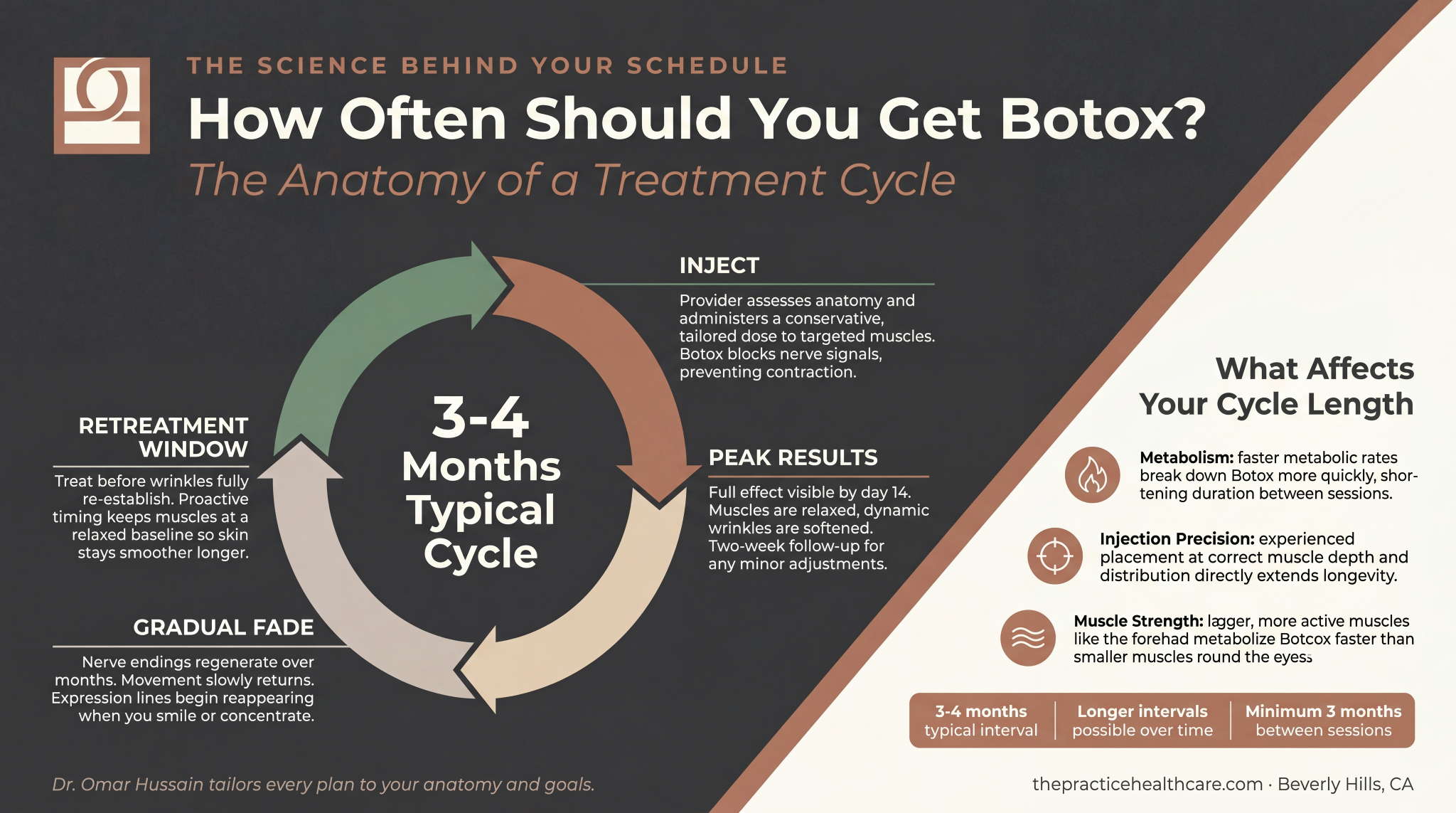
Botox results typically last three to four months, though individual timelines vary. Several factors influence how long your results hold:
First-time patients may notice shorter duration initially. With consistent treatment, muscles gradually adapt to remain more relaxed, and intervals often lengthen over time.
Several patient-specific factors influence how quickly your body processes Botox:
Hormonal shifts also play a role. Women navigating perimenopause and menopause may notice changes in how long results hold, as fluctuating estrogen affects muscle tone, skin quality, and overall metabolism.
How often should you get Botox? For most patients, every three to four months provides the most consistent, natural-looking results. That schedule maintains steady muscle relaxation without allowing lines to fully re-establish between appointments.
With consistent treatment over time, muscles gradually condition to remain more relaxed, and some patients extend their intervals to twice per year.
That shift develops slowly and is not something to expect early on.
Dr. Omar Hussain tailors each patient’s cadence to their individual response, ensuring results remain consistent without overcorrection.
While every timeline differs, a standard Botox treatment plan typically follows this progression:

The general clinical recommendation is to space Botox treatments at least three months apart.
This interval allows the previous dose to wear off naturally, reduces the risk of product accumulation, and gives your provider an accurate read on how your muscles are responding.
A review in Clinical, Cosmetic and Investigational Dermatology confirmed that cosmetic use is safe with repeated injections when proper dosing protocols and treatment intervals are followed. Antibody resistance is rare but documented.
Using the lowest effective dose and maintaining adequate intervals between sessions are the primary strategies for preventing it.
Rather than tracking the calendar, pay attention to the physical cues that indicate your Botox is wearing off. Scheduling at the right moment keeps results seamless and avoids visible aging between appointments.
Key signs it is time to book:
Treating proactively has a clinical rationale. When you allow wrinkles to fully re-establish between sessions, the muscles return to full contractile strength and lines can etch deeper into the skin over time.
Treating before that point keeps muscles at a more relaxed baseline, so the overlying skin stays smoother for longer.
A review in Annals of Plastic Surgery found that repeated injections produced persistent changes in muscle composition that lasted well beyond the typical three- to four-month window, suggesting that consistent treatment carries cumulative benefit.
Dr. Omar Hussain prioritizes natural expression alongside softened lines, adjusting dose and timing to each patient’s response.
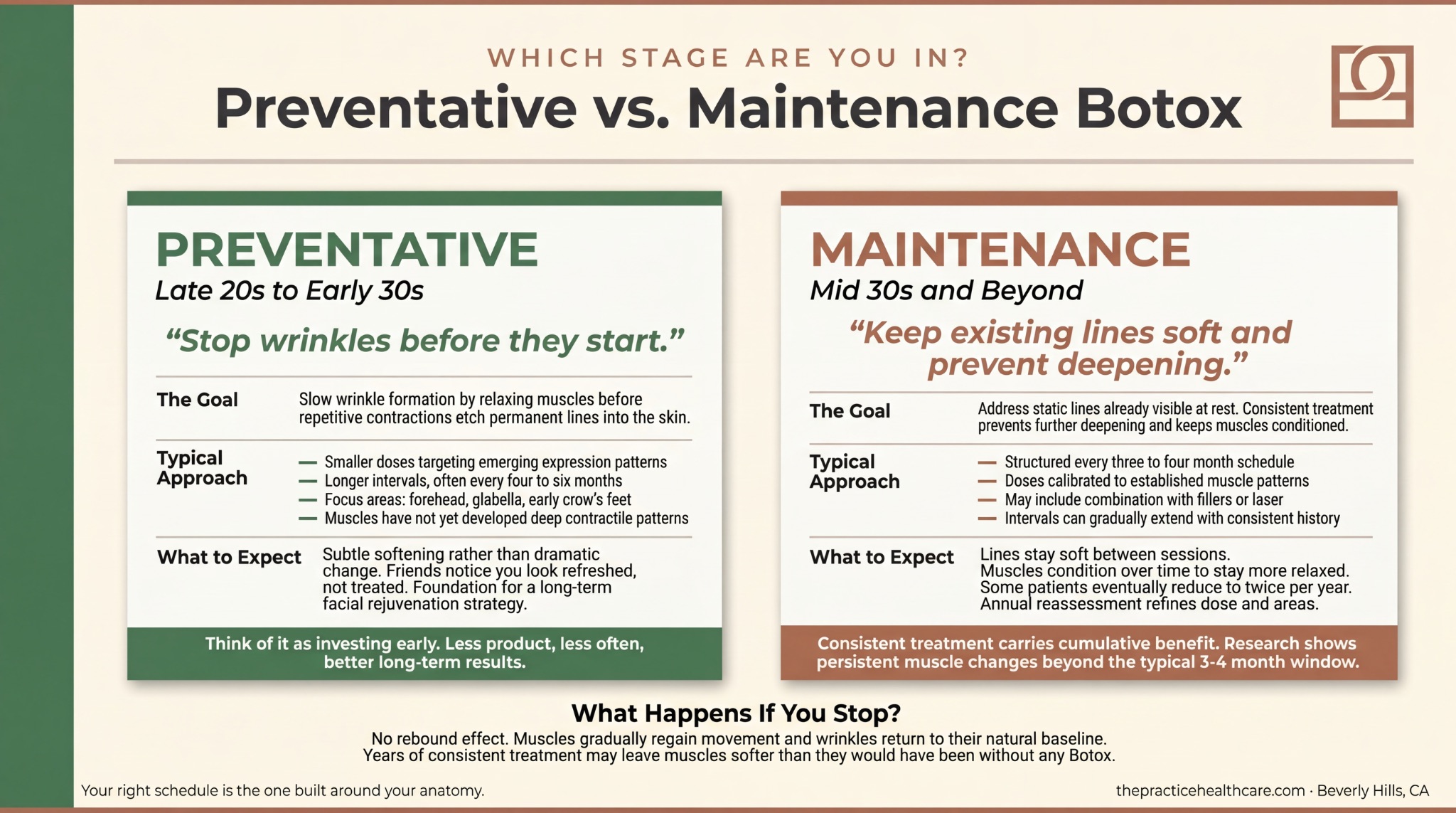
The right approach depends on where you are in your skin journey.
Preventative Botox targets patients in their late 20s to early 30s who want to slow wrinkle formation before lines become permanent. By relaxing muscles early, you prevent the repetitive contractions that eventually etch deep lines into the skin.
Doses are typically smaller and intervals longer, since younger muscles have not yet developed the contractile patterns seen in older patients.
Understanding the full spectrum of options, from preventive Botox to deep-plane facelift surgery, helps you build a long-term facial rejuvenation strategy that evolves with your needs.
Maintenance Botox addresses static lines that are already visible at rest. These wrinkles have developed over years of repetitive muscle contraction and require consistent treatment to stay soft and prevent further deepening.
Most maintenance patients follow a structured three to four month schedule.
Over time, your provider may adjust the dose as your muscles respond to repeated relaxation, or refine the treatment areas as your face ages naturally.
For some patients, intervals gradually extend with a consistent treatment history, though that shift develops slowly and is not immediate.
Stopping Botox does not worsen your skin beyond its natural baseline.
Your muscles gradually regain full range of movement, and softened wrinkles return to their pre-treatment appearance. There is no rebound effect.
If you have been treated consistently over several years, your muscles may retain some conditioning, so lines could appear softer than they would have without any treatment. That varies by patient and depends on duration and consistency of care.
Pausing carries no medical risk. How well your results hold over time reflects the same principle behind optimizing post-treatment recovery: outcomes are better when managed by experienced professionals.
So how often can you get Botox before it becomes a problem? The clinical answer is that treating more frequently than your muscles actually need can lead to over-relaxation, a heavy or frozen appearance that reduces the subtle movement that keeps your face looking natural.
There is also a safety consideration. A review in Advances in Dermatology and Allergology confirms that antibody resistance risk increases with frequent high-dose injections. Dr. Omar Hussain monitors each patient’s response over time, adjusting both dose and schedule to maintain consistent, natural results without the risks of overtreatment.
A personalized Botox plan accounts for your facial anatomy, muscle activity, skin quality, and how your body responds over time. That specificity is what separates consistent, natural results from generic ones.
A well-structured plan includes:
For patients who have had or are considering facelift surgery, Botox complements surgical outcomes by preventing new dynamic wrinkles from forming over time.
For most patients, every three to four months delivers consistent, natural-looking results.
Over time, with expert guidance, some patients extend their intervals as muscles respond to consistent treatment.
The right schedule is the one built around your anatomy and goals. Dr. Omar Hussain at The Practice Healthcare works with you to develop a plan that fits your lifestyle and evolves with your needs. Contact us to get started.
How often should you get Botox for forehead lines? Most patients benefit from every three to four months. The frontalis is a larger, more active muscle, so stronger activity may shorten your interval. Your provider will monitor response patterns to establish your ideal schedule.
How often can you get Botox safely? At least every three months is the general recommendation, allowing the previous dose to metabolize naturally and reducing antibody risk. Proper dosing and provider oversight are equally important for maintaining safe, effective long-term results.
Some patients notice longer-lasting results after consistent treatment cycles, as muscles condition to a more relaxed state. This is not universal and depends on metabolism, muscle strength, and treatment area. An experienced injector gives you the best chance of extending your intervals over time.
Getting Botox every two months is generally not recommended. Treating too frequently risks over-relaxing muscles, producing an unnatural appearance, and raising the chance of neutralizing antibody development. How often can you get Botox optimally? Every three to four months remains the clinically supported standard.
Long-term Botox use has an extensive safety record spanning decades. Many patients are treated consistently for 10 to 20 years without significant adverse effects. Annual reassessment of dose and schedule by an experienced injector ensures your plan continues matching your evolving anatomy and goals.
Facelift Surgery: The Complete Guide to Modern Techniques, Recovery, and Results
What Is a Chemical Peel and How Does It Improve Your Skin?
How to Prepare for Plastic Surgery: Simple Step-by-Step Guide
Stay in the know with our latest press coverage and helpful content updates to keep you informed.