


Share this post


Your skin renews itself roughly every 28 days, but that cycle slows with age, sun, and stress. A chemical peel helps restart the process.
Within 30 minutes, a medical-grade acid solution lifts away damaged cells layer by layer, so fresher, brighter skin can surface underneath. Different types of chemical peels target different concerns, from fine lines and acne scars to sun spots and uneven tone.
At The Practice Healthcare Medspa in Beverly Hills, our master nurse practitioner selects the right peel depth for your skin type and goals, so you get real results, not guesswork.
A chemical peel, also called chemexfoliation, is a skin resurfacing treatment that applies a chemical solution to your skin. The solution breaks down the bonds between damaged outer cells, allowing them to shed and reveal fresher skin underneath.
But the surface change is only half the story.
Over the following weeks, that turnover stimulates collagen production, which gradually improves texture, tone, and clarity. According to the American Academy of Dermatology, chemical peels effectively treat signs of aging, acne, uneven skin tone, and sun damage.
Not every peel works the same way, though. They range from superficial to deep, depending on how much correction your skin needs. That's why at The Practice Healthcare, Kennedy James, our master nurse practitioner with a dermatology background, matches peel depth to your concerns and sensitivity.
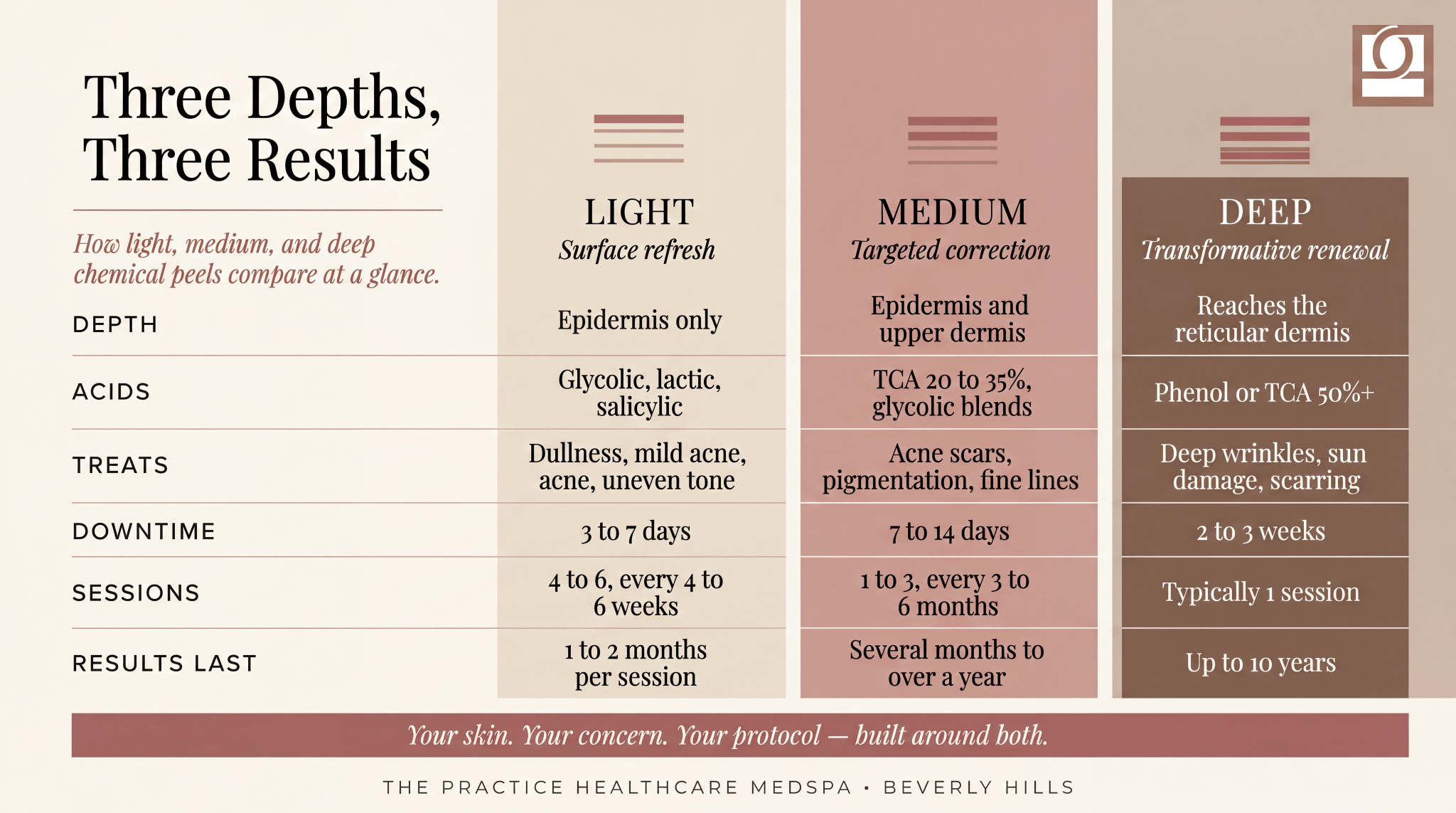
So what makes one chemical peel different from another? It comes down to depth.
The types of chemical peels available are grouped into three levels: light, medium, and deep, each using different acids to reach different layers of your skin. Because every layer treats a different concern, the right peel depends on what your skin actually needs. Here's how each one works.
Also known as a superficial peel, a light chemical peel removes only the outermost skin layer using mild acids like glycolic, salicylic, or lactic acid.
Recovery is minimal: you'll see about three to seven days of light flaking without real social downtime. According to the Cleveland Clinic, this is an effective chemical peel for acne, dullness, and early signs of aging. A series of sessions builds noticeable results over time.
If you're dealing with moderate skin concerns, a medium chemical peel reaches through the epidermis into the upper dermis using trichloroacetic acid (TCA), sometimes blended with glycolic acid.
That deeper penetration makes it the go-to chemical peel for hyperpigmentation, post-acne scars, uneven texture, and deeper fine lines. Afterward, expect seven to fourteen days of visible peeling and redness, with real improvement typically after one to three sessions spaced several months apart.
A deep chemical peel reaches the reticular dermis using high-concentration phenol or TCA.
As a result, it delivers the most dramatic results of the three, significantly reducing deep wrinkles, severe sun damage, and pronounced scarring. Recovery takes two to three weeks.
According to the American Society of Plastic Surgeons, a single deep chemical peel can produce results that last up to 10 years. Given the intensity, you'll need careful candidate screening and an experienced provider.
| Peel Type | Depth | Acids Used | Conditions Treated | Downtime | Sessions | Results Last |
| Light | Epidermis only | Glycolic, lactic, salicylic acid | Mild acne, dullness, uneven tone | 3 to 7 days | 4 to 6 sessions, every 4 to 6 weeks | 1 to 2 months per session |
| Medium | Epidermis + papillary dermis | TCA 20 to 35%, glycolic acid blends | Acne scars, hyperpigmentation, fine lines | 7 to 14 days | 1 to 3 sessions, every 3 to 6 months | Several months to 1+ years |
| Deep | Epidermis + reticular dermis | Phenol or TCA 50%+ | Deep wrinkles, severe sun damage, scarring | 2 to 3 weeks | Typically 1 session | Several years |

When a chemical peel removes damaged cells, your body reads it as an injury and triggers repair. Fibroblasts travel to the area and produce new collagen and elastin.
As a result, over the following weeks, your skin firms up, texture smooths, and tone evens out.
According to Healthline, this is why peels effectively treat fine lines, sun damage, acne scars, hyperpigmentation, and uneven tone. The chemical peel benefits you see are this repair cycle showing on the surface.
To extend those results, you can pair peels with other nonsurgical facial rejuvenation treatments.
Because peels work at different depths, they can address a wide range of skin concerns. That's why Aubrey Mench and Oanh Nguyen, our licensed nurse practitioners, use them to treat:
If more than one of these sounds familiar, a peel can treat several at once.
A chemical peel is a solid fit if you have any of the concerns above, realistic expectations about results, and room in your schedule for recovery. Fair to medium skin tones generally respond well across all three types of chemical peels.
However, darker skin types are still excellent candidates. You just need careful acid selection and an experienced provider to reduce the risk of post-inflammatory hyperpigmentation.
If you'd rather skip downtime entirely, you can also explore skin tightening without surgery as an alternative or complementary approach.
Before booking, a consultation confirms whether a chemical peel is right for you. In general, you should postpone or skip one if you:
When in doubt, ask. Your provider will tell you what's safe.
Knowing what happens at each stage takes the guesswork out of your appointment. So here's exactly what to expect, from the moment you arrive to the moment you walk out.
First, your master nurse practitioner assesses your Fitzpatrick skin type, current routine, past treatments, and concerns.
Based on that, she selects the right chemical peel depth and acid concentration for your skin.
Then, in the week before your appointment, you should stop retinoids, exfoliating acids, and waxing in the area. Some patients also receive a pre-peel conditioning regimen with hydroquinone or low-dose retinol to reduce the risk of post-peel pigmentation.
The treatment itself takes 30 to 45 minutes.
First, your skin is cleansed and degreased to remove barrier oils. Then the acid solution is applied in controlled passes. As it works, you'll feel a mild tingling or warming, which is normal.
After a timed period, the solution is neutralized or removed. You'll leave with a light flush or visible redness, depending on whether it's a light or deep chemical peel.
Right after your chemical peel, your skin will feel tight and look pink.
Visible peeling usually starts two to four days later. Before you leave, your provider walks you through aftercare: cleansing, moisturizing, and protecting your skin during chemical peel recovery.
Avoid picking the peeling skin, since that's the most common cause of scarring. The full chemical peel before-and-after difference becomes apparent around the two-week mark.
So, how long does chemical peel recovery take?
The honest answer: it depends on three things. First, the peel depth you chose. Second, your skin's baseline sensitivity. And third, how closely you follow aftercare. Nail those, and recovery becomes straightforward.
Once you know what controls chemical peel recovery time, here's what each depth actually looks like:
To make the most of that window, it helps to see how our team approaches post-treatment recovery across our treatments.
Once you're home, the right habits protect your results. Follow these through the full recovery window:
Stay consistent with these, and your skin will do the rest.
Beyond a single peel, your bigger question is likely how many you'll need. The short answer: it depends on peel depth and what you're correcting, so there's no universal protocol.
Here's what to expect by type:
If you're weighing your options, a chemical peel is one of several non-surgical ways to improve your skin. How it stacks up against the alternatives comes down to three things: your specific concern, how deep you want the correction to go, and how much downtime you can realistically handle.
So before you commit, it's worth seeing where peels fit alongside other non-surgical facial rejuvenation options.
| Treatment | How It Works | Downtime | Best For |
| Chemical Peel | Acid solution removes damaged skin layers | 3 days to 3 weeks | Acne, hyperpigmentation, wrinkles, sun damage |
| Microdermabrasion | Physical crystal or diamond tip exfoliation | Minimal (1 to 2 days) | Surface dullness, very mild texture issues |
| Laser Resurfacing | Targeted light energy removes skin layers and heats the dermis | 5 to 14 days | Wrinkles, scars, pigmentation, and significant skin laxity |
| Microneedling | Micro-injuries stimulate collagen production | 2 to 4 days | Texture, mild scarring, skin firmness |
How much does a chemical peel cost? Your total depends on peel depth, provider expertise, and where you live. According to the American Society of Plastic Surgeons, the average cost of a chemical peel is $1,829.
Medical-grade pricing is higher than spa options because acid concentrations, protocols, and provider qualifications are held to clinical standards.
Beyond cost, every skin treatment carries some risk. Knowing the chemical peel side effects helps you go in with clear expectations.
The most common effects you'll see during recovery are temporary redness, tightness, peeling, and sun sensitivity.
Less common effects include temporary skin darkening or lightening (especially in darker tones without preconditioning) and cold-sore flares after a deep chemical peel. The American Academy of Dermatology reveals that scarring is very rare with professional care and is usually associated with how well you follow aftercare instructions
At The Practice Healthcare Medspa in Beverly Hills, your chemical peel consultation starts with one of our nurse practitioners.
They will select your acid and protocol based on your skin assessment, not a preset menu.
Because The Practice also houses surgical specialists, you can weigh peels against more intensive options under one roof. If you're comparing approaches, see what a facelift involves and how a deep-plane facelift differs before deciding which fits your goals.
Every chemical peel before-and-after outcome here reflects that level of personalization.
A chemical peel is one of the most reliable treatments in medical aesthetics. Light, medium, or deep, the right peel from the right provider can genuinely shift your skin's trajectory, especially when paired with a consistent routine and daily sun protection.
At The Practice Healthcare Medspa in Beverly Hills, Kennedy James and our team will match you to the right protocol. Book your consultation and start seeing the chemical peel before-and-after results you've been looking for.
A chemical peel applies an acid solution to remove damaged outer skin through controlled exfoliation, triggering the growth of new cells and collagen production. The acid type and concentration determine the depth, which controls how many skin concerns it can address.
Chemical peel cost in Beverly Hills varies by depth and provider. Light peels start around $150 per session, medium peels run $1,000 to $3,000, and deep peels often exceed $3,000. Provider expertise and facility type influence the total.
Yes. A chemical peel for acne is one of the most common uses for this treatment. Medium-depth TCA peels work well for shallow to moderate post-acne scarring. Severe scarring may require a series of sessions or complementary treatments, such as microneedling.
Chemical peel recovery depends on depth. A light chemical peel peels minimally for 3 to 7 days. Medium peels flake visibly for 1 to 2 weeks. A deep chemical peel needs 2 to 3 weeks of careful healing. Daily sunscreen is non-negotiable.
Yes. A chemical peel for hyperpigmentation lifts pigmented surface cells and evens melanin distribution underneath. Medium-depth peels work well for melasma, sun spots, and post-inflammatory hyperpigmentation. Multiple sessions paired with consistent daily SPF produce the most lasting results.